The Colored Conventions Movement: A Timeline of Black Political Power
✊🏽 Introduction
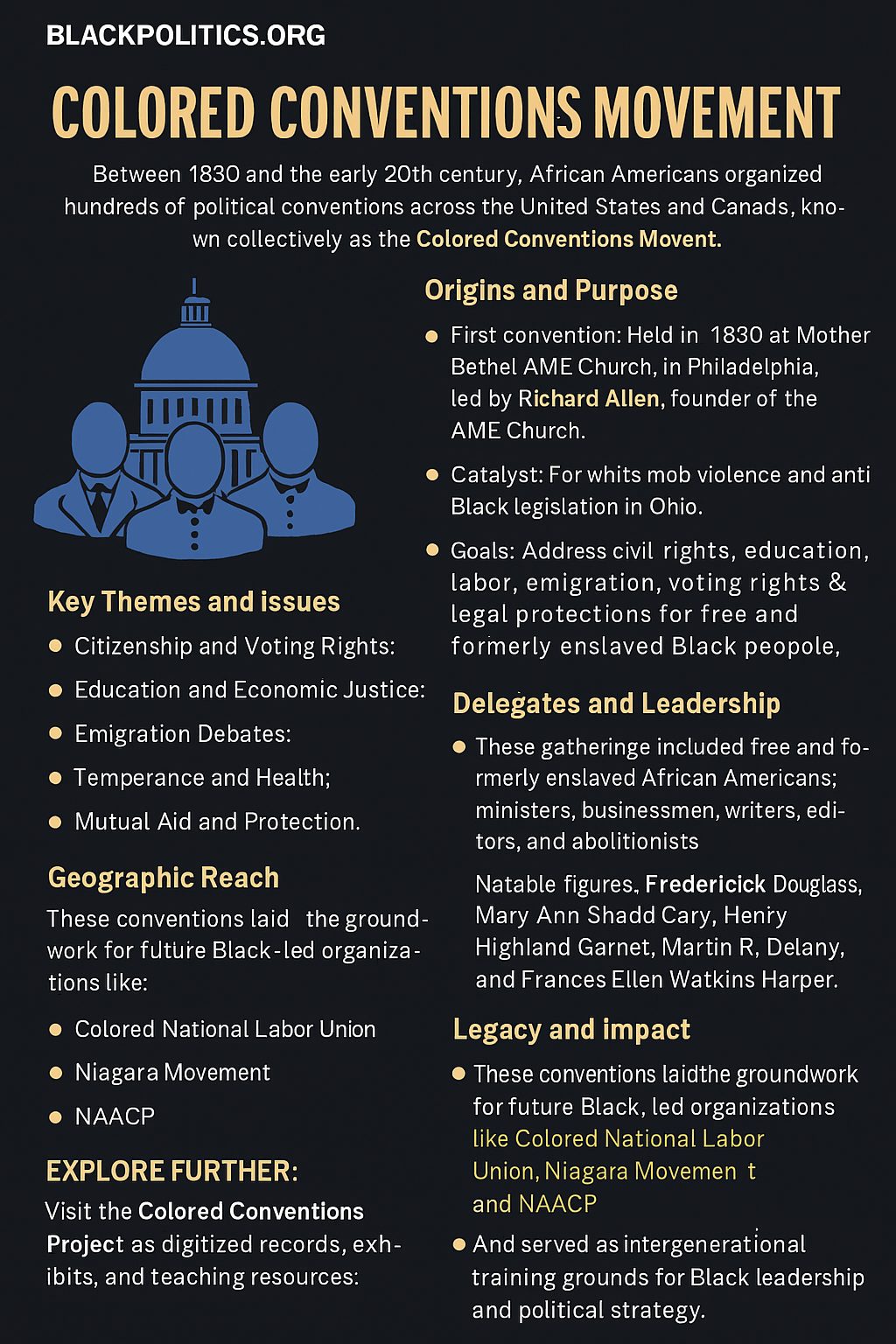
From the earliest days of American democracy, African Americans convened to demand justice, strategize for liberation, and build infrastructure for collective power. Long before the Civil Rights Movement or the founding of the NAACP, Black leaders organized hundreds of political conventions across the U.S. and Canada—laying the groundwork for every major racial justice movement that followed.
This is the story of the Colored Conventions Movement, a foundational chapter in African American political history.
📜 What Were the Colored Conventions?
First Convention
🕊️ 1830, Philadelphia — Led by Bishop Richard Allen at Mother Bethel AME Church, responding to white mob violence and anti-Black laws in Ohio.
Core Goals (List Block)
- Secure voting rights and legal protections
- Expand access to education and employment
- Debate emigration to Canada or Liberia
- Build mutual aid networks and community defense
🔍 Key Themes That Still Resonate
Citizenship & Voting Rights
Delegates demanded full political participation and framed disenfranchisement as systemic violence.
Education & Economic Justice
Equal schooling and economic opportunity were seen as pillars of freedom.
Emigration Debates
Some advocated relocation to escape U.S. racial oppression; others insisted on fighting for change at home.
Temperance & Health
Conventions tackled public health, moral uplift, and social reform.
Mutual Aid & Protection
Delegates built networks to support Black communities under siege.
🧑🏽🤝🧑🏽 Who Led These Conventions?
The movement brought together a cross-section of Black leadership—ministers, educators, journalists, entrepreneurs, and abolitionists.
Notable Figures (List Block)
- Frederick Douglass
- Mary Ann Shadd Cary
- Henry Highland Garnet
- Martin R. Delany
- Frances Ellen Watkins Harper
These leaders shaped not just the conventions, but the trajectory of Black political thought.
🗺️ Geographic Reach of the Colored Conventions Movement
Over 500 conventions were held in 29 states, Washington, D.C., and Ontario, Canada. After the Civil War, the movement expanded into the South:
Southern Expansion (List Block)
- Tennessee
- Mississippi
- Alabama
- South Carolina
- Georgia
These gatherings created regional networks of resistance and laid the foundation for future organizing.
🧬 Legacy and Impact
The Colored Conventions Movement seeded the infrastructure for:
- Colored National Labor Union
- Niagara Movement
- NAACP
- Black-led education, press, and civic institutions
It also trained generations of Black leaders in strategy, coalition-building, and policy advocacy.
🖼️
🔗 Explore Further
Resources:
- Colored Conventions Project — Digitized records, exhibits, and teaching resources
- Cornell’s Black Print Exhibit — Curated insights into themes and participants
📣 Call to Action
At BlackPolitics.org, we honor this legacy by building tools for civic accountability and historical memory. Our ZIP code lookup widget and Federal Equity Scorecard are direct descendants of this movement’s vision: empowering Black communities with data, strategy, and voice.
Support Our Work
- 🔗 Join Our Mailing List
- 💬 Share This Post
- 💰 Contribute to Our Campaigns
About The Author