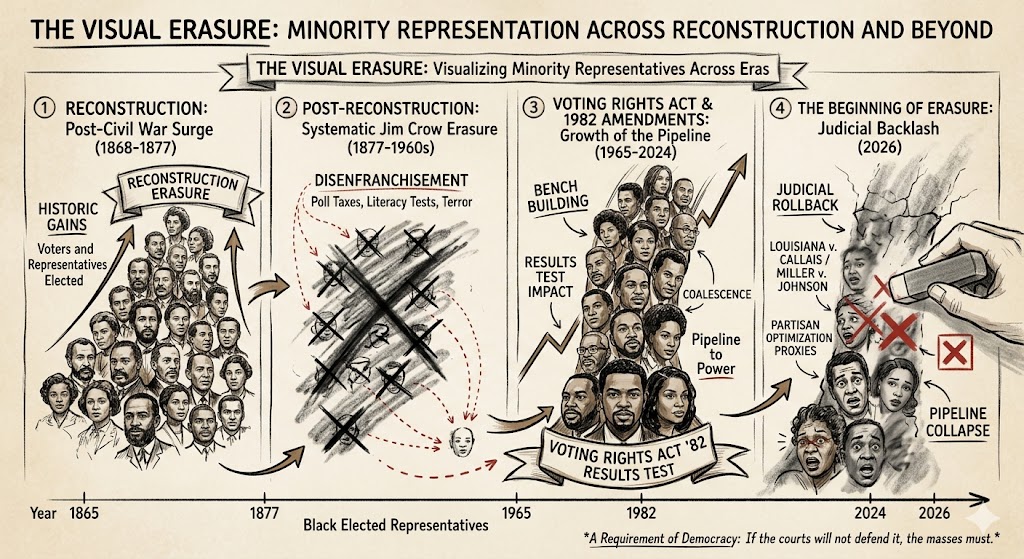
The Visual Erasure of Black Political Power
The Dismantling of Black Political Power Since Louisiana v. Callais – The Architecture of Disenfranchisement: Unmasking the Third Counter-Reconstruction
By Selwyn Carter | Editor-in-Chief, Black Politics & Former Voting Rights Programs Director, Southern Regional Council
The fallout from Louisiana v. Callais: the erasure of Black political power signals a coordinated, systemic assault designed to strip away the electoral choices of Black voters and suppress Black political power across the American South. Thirty years ago, sitting inside the Atlanta offices of the Southern Regional Council during a deeply polarized special legislative session, I witnessed the early blueprints of this backlash and wrote an analysis that’s worth reflecting on today. My work during that era belongs to a broader legacy of the Southern Regional Council and Black Political Power—a multi-decade struggle for structural equity that directly mirrors the crisis threatening us once again today.
At the time, SRC Board members included leaders like Bennie Thompson of Mississippi and Jim Clyburn of South Carolina—men who would become the bedrock of Southern congressional power, but who were then deeply embedded in our shared institutional fight for the creation of districts offering Black voters the opportunity to elect candidates of their choice. The year was 1995. The Supreme Court had just handed down Miller v. Johnson, striking down Georgia’s majority Black 11th Congressional District. In the Fall 1995 edition of the Voting Rights Review, I warned that the High Court’s newly minted “racial gerrymandering” standard was a trap: a standard so vague and impossible to define that it would inevitably be used to turn back the clock on Black voters.
The New Literacy Test: From the Billy Club to the Bench
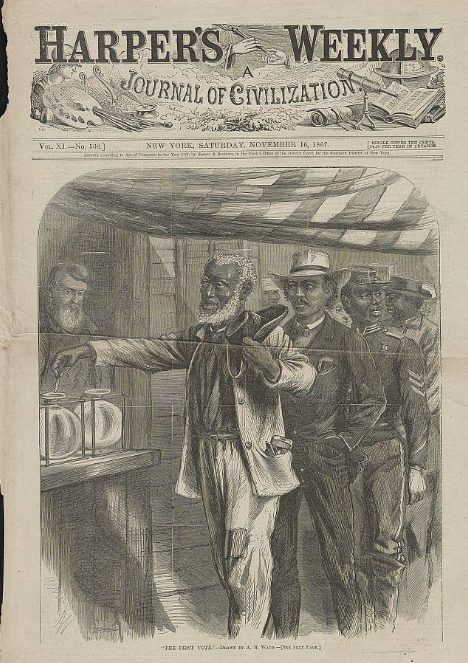
The methods of disenfranchisement have evolved from the crude to the sophisticated. We have transitioned from an era of the physical billy club to the sterile legalism of the judicial bench. The Callais decision exposes how the Supreme Court uses the constitutional requirement of “Strict Scrutiny” not as a shield to protect vulnerable citizens, but as a sword to dismantle the very mechanisms designed to fulfill the core promise of the Fifteenth Amendment: that the right to vote shall not be denied or abridged on account of race.
By framing the conscious creation of majority black districts and opportunity districts as an inherent constitutional “injury” to non-Black voters, the Court has weaponized “colorblind” language to mandate the functional deletion of Black political power. It is a modern, high-tech literacy test—wrapped in dense, procedural jargon, but engineered to achieve the exact same historic result: ensuring the halls of power remain structurally exclusive. At Black Politics, we have defined electoral politics as the structural fault line of the black freedom struggle. Since Reconstruction, Black voters have rarely held the autonomous legislative majorities required to independently enact transformative policy, rendering electoralism to many black activists as a perpetual arena of unfulfilled promises. Yet, electoral politics remains our gravitational center because white supremacy has always recognized it as the seismic force capable of reconfiguring Southern society. Thus, the legal engineering in Callais is not a response to a broken system; it is a calculated assault precisely because the system worked, proving once again that whenever Black electoral power surges, a systemic counter-revolution or Third Counter-Reconstruction rises to destroy it.
The 40-Year Surge and the Vanguard Coalition
To understand the magnitude of what is being dismantled, we must honor the infrastructure that built it. The monumental breakthrough of the 1982 Voting Rights Act amendments didn’t happen in a vacuum. It was forged by a relentless vanguard coalition—the Southern Regional Council, the NAACP Legal Defense and Education Fund (LDF), The Lawyers’ Committee for Civil Rights Under Law, the ACLU, the NAACP, and an army of voting rights technical experts, among others.
This ecosystem established an unyielding legal standard: the “Results Test.” For over forty years, the law did not concern itself with the hidden, unprovable intent of a southern politician’s heart; it only cared if the resulting map was fair. The real-world numbers of this victory speak for themselves:
| Representation Metric | 1980 Era | 2026 Era | Structural Growth |
| Congressional Black Caucus (CBC) | 17 Members | 60+ Members | ~250% Increase |
| Southern State Legislative Caucuses | Entrenched Minority | Robust Legislative Benches | 300% Growth |
This massive surge proved that when the choice of Black voters was backed by an enforceable federal engine, democracy could finally begin to look multiracial.
The Southern Sacrifice Zones: Camouflage and the Core Metaphors
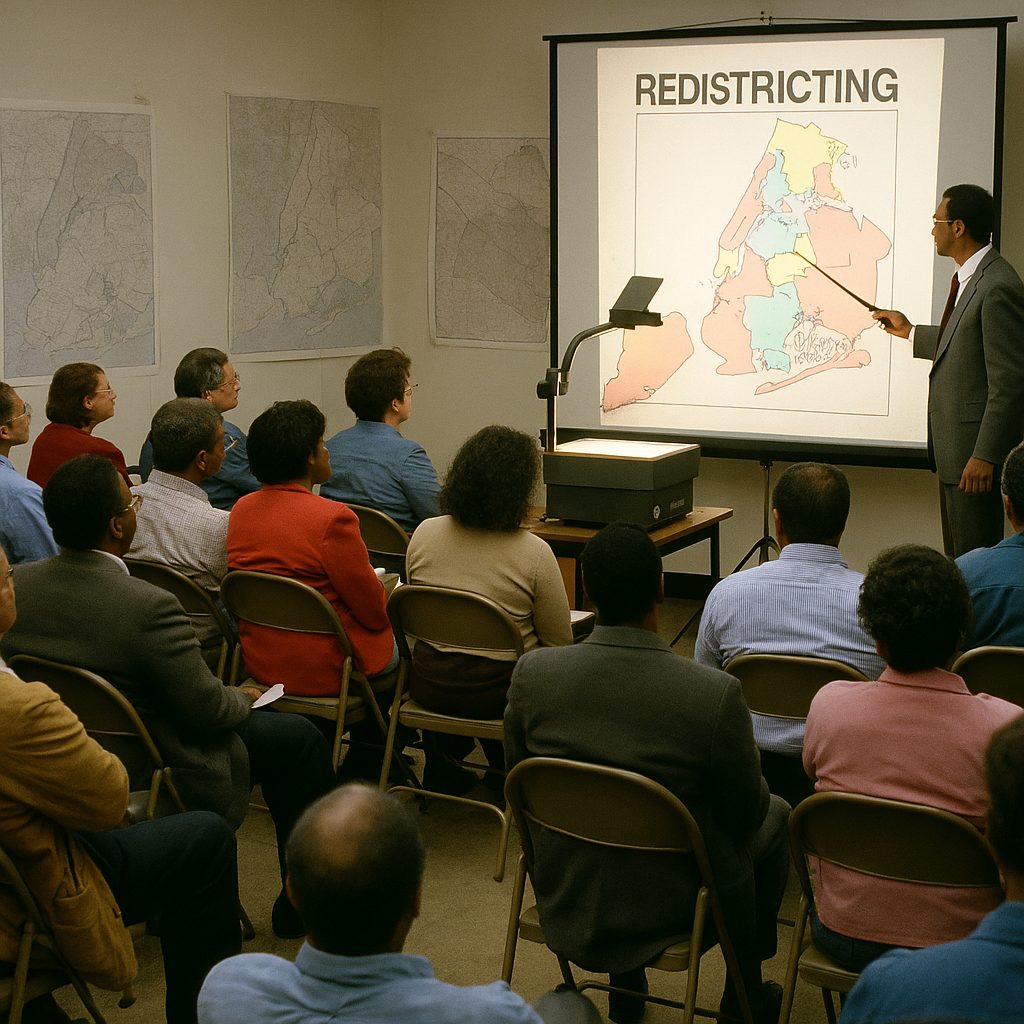
The modern corporate media continues to repeat the lazy myth that redistricting is merely a partisan tug-of-war between Democrats and Republicans fighting over control of the U.S. House of Representatives. This superficial script acts as a smoke screen for a deeper, more permanent structural erasure. Under the Court’s new logic, states are given a free pass to dilute the Black electorate, provided they claim they are simply targeting “Democrats.”
To the masses, this legal shell game can be understood through two classic geographic maneuvers: Packing and Cracking.
- Packing draws lines tightly around Black communities, shoving as many Black voters into a single district as possible to waste their surplus voting strength.
- Cracking does the exact opposite: it splinters a dense Black community across multiple white-dominated districts, diluting their numbers so they can never form a cohesive voting majority.
By allowing partisanship to serve as the perfect legal excuse, the Court is turning the American South into a series of structural sacrifice zones, threatening a projected 20% to 30% drop in Black representation over the next decade.
The Incumbency Lifeboat: Safe Harbor or Structural Prison?
In the wake of Callais, southern mapmakers are increasingly employing a cynical strategy known as Core Retention—or what can be best described as the Incumbency Lifeboat. By drawing maps that protect veteran, long-serving Black incumbents, state legislatures insulate themselves against charges of ‘racial predominance’ while appearing superficially fair.
This presents a dangerous, structural paradox:
- The Safe Harbor: It provides short-term protection for current, veteran Black leadership, ensuring they retain their seats.
- The Structural Prison: It places an artificial, permanent ceiling on the map. It prevents the creation of new opportunity districts for rapidly growing Black populations, freezing Black political expansion in place while the surrounding electorate is shifted around them.
Organizing the Resistance to the Third Counter-Reconstruction: A Roadmap to Win
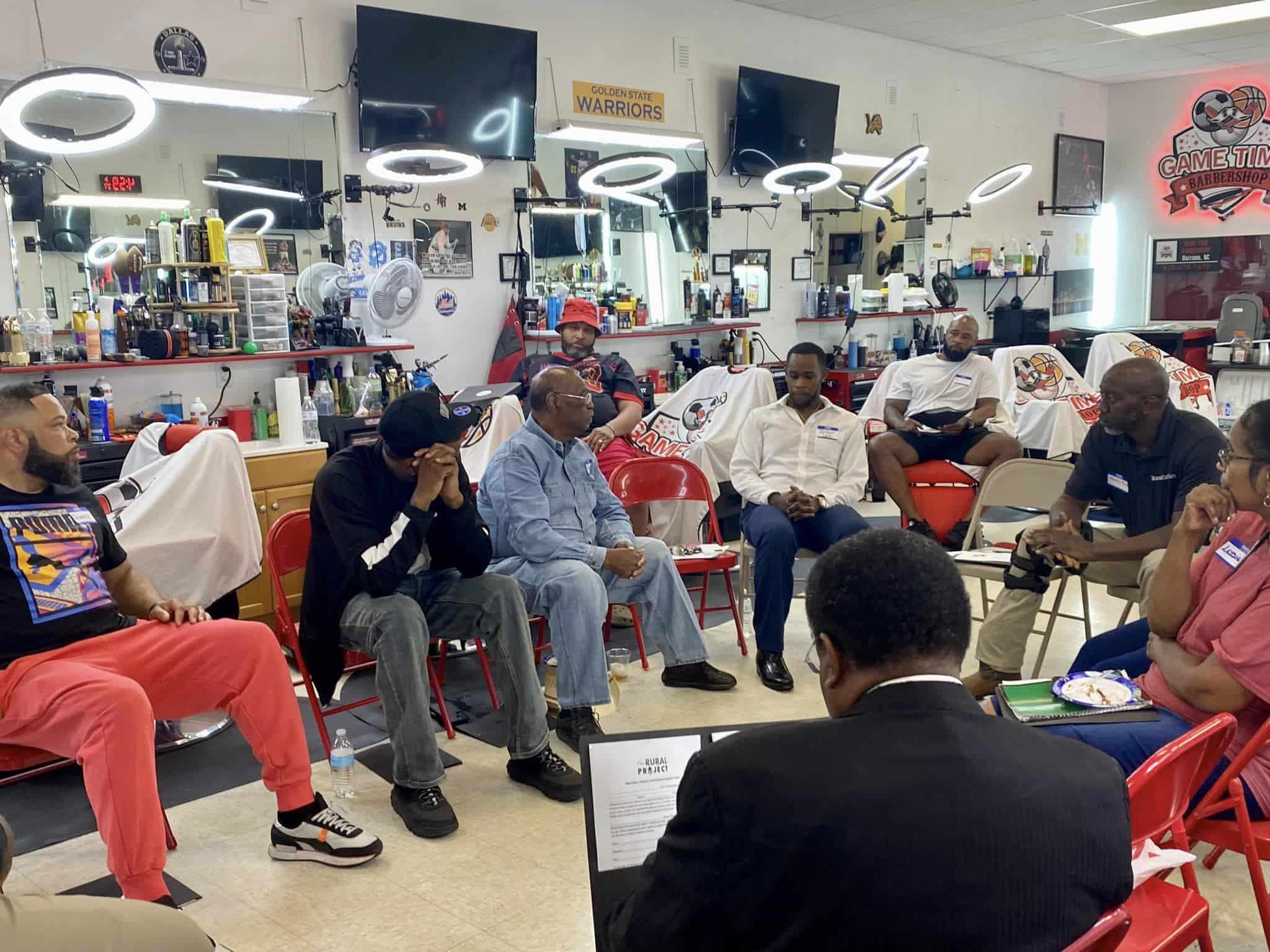
When the federal courts fail to act as guardians of the Constitution, the masses must become the architects of their own defense. The resistance to this Third Counter-Reconstruction cannot be confined to the courtroom; it must be waged across three distinct, actionable fronts:
- State-Level Voting Rights Acts: We must aggressively push for state-level VRAs—modeled after robust frameworks in New York and California—that protect local, county, and state legislative maps completely independent of federal judicial overreach.
- Overwhelming the Gerrymander and the Strategic Pivot: We must answer the structural challenge with unprecedented mobilization. Can mass grassroots turnout completely overwhelm even the most meticulously engineered “partisan proxy” maps? History shows that when the electorate is organized at the precinct level, artificial boundaries can crack under the weight of collective will. But turnout alone is no longer enough when the lines are actively rigged; we must couple that ground game with a mature, unyielding conversation within the Black community about how we maximize our collective choice. Where it makes sense, we must leverage our undeniable power within the Democratic party structure. However, where gerrymandered maps leave us completely stranded without an alternative choice—particularly in the deep, rural South—we must be willing to pivot to more controversial, asymmetric strategies. This may mean organizing Black voters to temporarily register or vote in Republican primaries to disrupt hostile majorities from within. Furthermore, where local laws allow for flexibility, we must master the architecture of fusion politics or explore the creation of independent Black parties to hold the establishment accountable. When the rules of the game are engineered to erase us, we must change how we play the game.
- A Supreme Court-Proof John Lewis VRA: Our federal legislative demands must shift. We no longer need standard reauthorizations; we require a modernized, ironclad John Lewis Voting Rights Act specifically written to strip the current high court of its ability to narrow Section 2 protections.
The Florida Model: Constitutional Elevation
Mechanism: Constitutional Amendment (Article III, Sections 20 & 21)
Strategic Paradigm: To secure a broad, multi-racial coalition—most notably gaining the non-negotiable support of African American legislators—advocates built a bridge between federal mandates and state law. Rather than relying on volatile statutory frameworks, the 2010 coalition successfully elevated the federal Voting Rights Act’s (VRA) “non-diminishment” standard directly into the Florida Constitution.
Vulnerability under Callais: State executives have moved to weaponize the U.S. Supreme Court’s 6–3 holding, arguing that because federal strict scrutiny no longer treats VRA compliance as a per se compelling state interest, Florida’s own state constitutional protections are nullified if they dictate race-conscious map drawing.
The California Model: Statutory Protection Against At-Large Dilution
Mechanism: Statutory Enactment (California Voting Rights Act of 2001 – CVRA)
Strategic Paradigm: The CVRA was specifically engineered to dismantle the localized dilution of minority voting power inherent in at-large election systems. By lowering the evidentiary burden established under the federal Gingles framework, the CVRA eliminated the requirement that a minority community prove it is geographically compact enough to form a single-member district. Instead, plaintiffs need only prove the presence of racially polarized voting to force a transition to district-based seats.
Vulnerability under Callais: While primarily focused on local municipal governance rather than congressional line-drawing, the logic of the CVRA remains susceptible to the federal judiciary’s expanding “colorblind” doctrine. If conservative litigants bring 14th Amendment Equal Protection challenges against CVRA-mandated districts, the Supreme Court’s aggressive rewriting of strict scrutiny standards could leave state-level statutory remedies highly exposed to federal overrules.
The New York Model: Parallel Preclearance and Structural Buffers
Mechanism: Comprehensive Statutory Preclearance (John R. Lewis Voting Rights Act of New York – NYVRA)
Strategic Paradigm: Enacted as a direct response to the federal dismantling of VRA Section 4(b) in Shelby County v. Holder, the NYVRA codified a state-level preclearance civil rights buffer. The statute forces specific jurisdictions with histories of voter suppression to obtain explicit approval from the New York Attorney General or a designated state court before implementing any alterations to voting procedures, district lines, or polling places.
Vulnerability under Callais: By aggressively gutting Section 2 of the VRA, the Supreme Court has significantly altered the baseline of what constitutes a “permissible” use of race in state demographic tracking. New York’s model relies on the state’s sovereignty to enforce its own equity standards, but the Callais decision signals that the federal judiciary is increasingly willing to treat state-level civil rights enforcement as a form of unconstitutional racial engineering.
Defending Majority Black Districts and the Future of Black Political Power
The Supreme Court’s April 29, 2026 ruling in Louisiana v. Callais serves as a stark, unambiguous warning shot. If we do not treat this structural siege as an absolute emergency, we are rapidly heading toward a retrogressive era where Black citizens retain the superficial right to cast a ballot, but lose the structural power to actually elect representatives and lead. [1, 2, 3, 4]
By altering the Gingles test to require a nearly impossible proof of intentional discrimination rather than discriminatory effects, the choice of Black voters is currently being treated by the highest court in the land as a threat to the Constitution. We must organize, document, and mobilize to prove the exact opposite: that our presence in power is not a dispensable partisan variable, but an absolute, non-negotiable requirement of American democracy. [1, 2, 3]
Walking through the halls of Southern state capitols in May 2026, the sense of déjà vu is staggering. Following the Supreme Court’s April ruling in Louisiana v. Callais, the floodgates of a Third Counter-Reconstruction have burst wide open. Governor Brian Kemp has signaled a special session to rewrite Georgia’s maps; Louisiana has frozen its primary elections to ensure the deletion of one of the state’s hard-won majority Black congressional districts; and Mississippi leadership is openly plotting to eliminate the state’s lone Black representative.
The mainstream media has arrived with its usual, superficial script. They tell the masses that this is a simple mid-decade power grab—a transactional, short-term skirmish between Democrats and Republicans fighting for control of the U.S. House of Representatives following a request by Donald Trump.
They are entirely wrong.
What we are witnessing is not a routine game of red-versus-blue political chess. It is the sophisticated activation of a long-term, structural project designed to do what the post-1982 Voting Rights Act had stopped: the complete decoupling of Black political participation from actual Black political power. Partisanship is merely the modern legal camouflage; the permanent neutralization of the Black electorate remains the unchanging objective.
To truly comprehend the magnitude of this assault, one must understand the historic fortress that the Roberts Court just reduced to rubble. In 1982, civil rights giants successfully pushed Congress to pass crucial amendments to Section 2 of the Voting Rights Act. These amendments explicitly overturned a previous, hostile Supreme Court ruling by establishing a clear statutory directive: plaintiffs no longer had to prove intentional discrimination by white lawmakers. Instead, Congress codified the “Results Test,” declaring that if a political process resulted in the dilution of minority voting strength, it was illegal under the law.
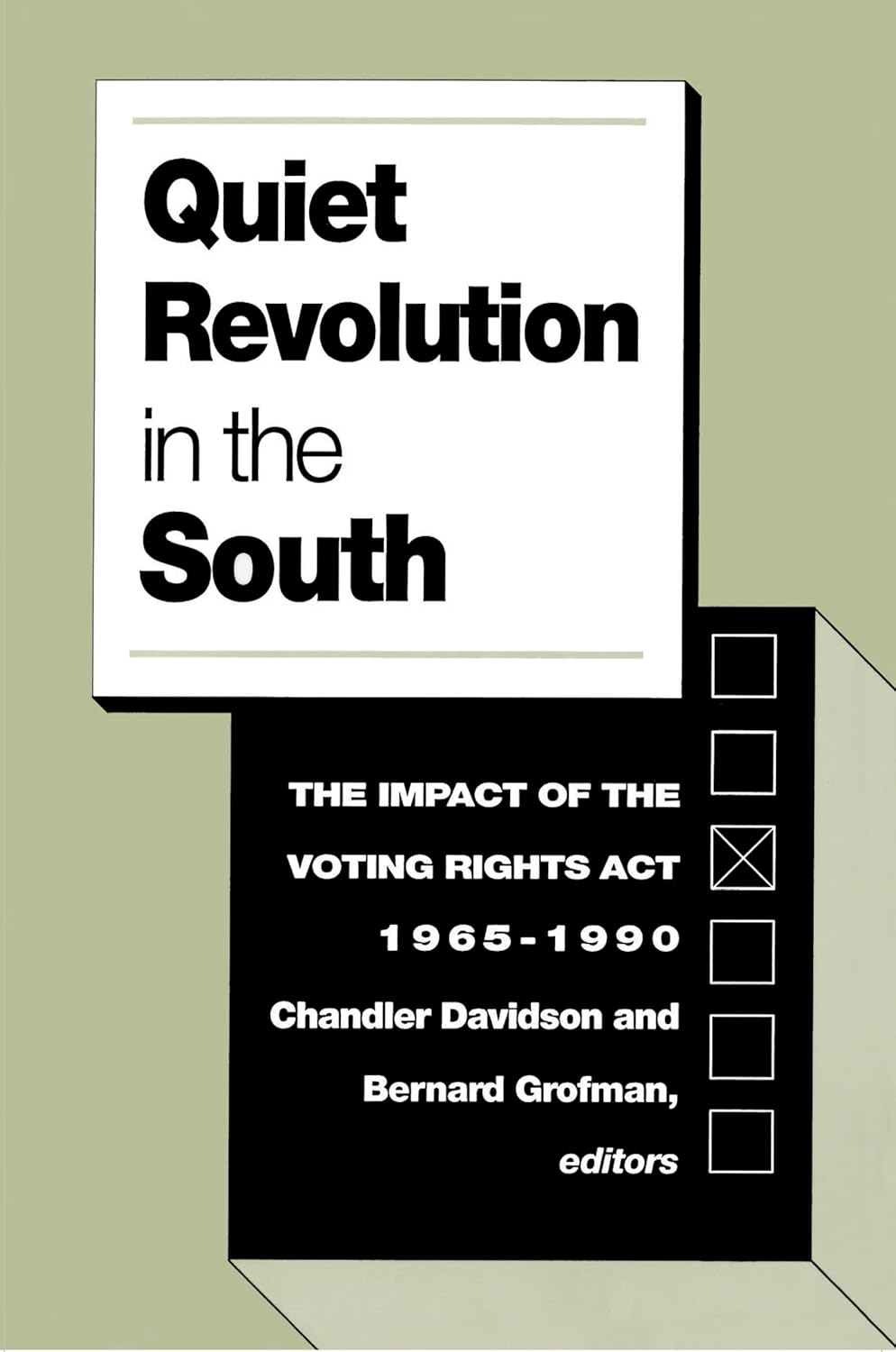
The early, empirical triumphs of this legislative shield were meticulously captured in the seminal study, Quiet Revolution in the South—a foundational text mapping the post-1965 struggle for equal political participation across eight core Southern states, authored by leading experts Chandler Davidson and Bernard Grofman, whose rigorous methodology set the baseline for modern voting rights analysis.
Four years after the 1982 Amendments to the Voting Rights Act of 1965, the Supreme Court normalized this protective shield in the landmark 1986 case Thornburg v. Gingles. Gingles established three simple, empirical conditions—the famous Gingles Factors—to prove vote dilution:
- A minority group must be large and compact enough to form a majority in a single-member district.
- The group must be politically cohesive (voting together as a bloc).
- The white majority must vote sufficiently as a bloc to consistently defeat the minority’s preferred candidate.
For forty years, this objective, data-driven framework served as the definitive baseline that forced Southern mapmakers to draw and defend majority Black districts.
The Callais decision completely eviscerates this Gingles paradigm. In a stark 6-3 ideological split, Justice Samuel Alito’s majority opinion effectively resurrects the pre-1982 era by injecting intent back into the equation through the side door of partisan camouflage. By demanding that plaintiffs somehow “disentangle” race from politics, the Court creates an impossible standard in a Southern political landscape where race and party preference are deeply polarized and structurally intertwined. Under the guise of a “technical update,” the Court now rules that Section 2 is only violated if there is a “strong inference of intentional discrimination,” meaning state legislatures are free to crack and dismantle majority-Black districts at will—so long as they claim their motives are purely partisan.
By fracturing the Gingles framework and declaring that compliance with the Voting Rights Act does not inherently constitute a compelling government interest under strict scrutiny, the Court has effectively closed the courthouse doors to future vote dilution claims. The choice of Black voters is currently being treated by the highest court in the land as a threat to the Constitution, a destabilizing force that must be contained through the camouflage of partisan warfare. We must organize, document, and mobilize to prove the exact opposite: that our presence in power is not a constitutional luxury or a partisan variable, but an absolute, non-negotiable requirement of American democracy.
The Architecture of the Pipeline: How the “Results Test” Built Black Political Power
To understand what is being dismantled in 2026, the masses must first understand how the modern Black and African American leadership pipeline was built. It was not a natural byproduct of shifting demographics; it was the direct result of a hard-fought legal revolution.
When Congress amended the Voting Rights Act in 1982, it overrode the Supreme Court’s hostile turn in Mobile v. Bolden (1980) by replacing an impossible “intent standard” with the revolutionary “Results Test” under Section 2. For the next four decades, the law didn’t care what was in a politician’s heart—it only cared if a map functionally shut out Black and African American voters.
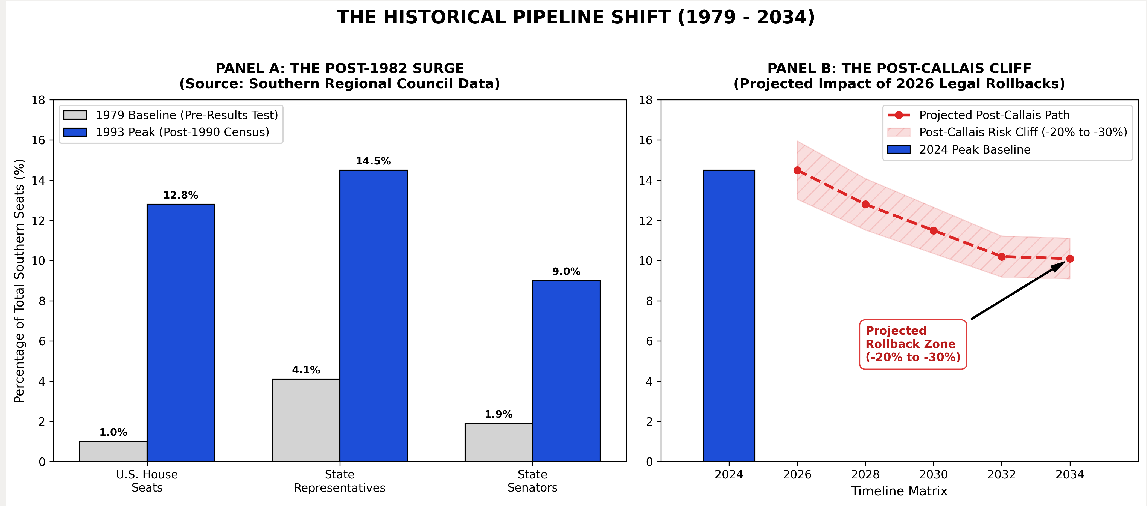
The quantitative proof of this revolution was documented heavily during my tenure at the Southern Regional Council. In our Voting Rights Review publications from 1992 through the Fall 1995 special issue, we charted the staggering growth of Black elected officials across eleven Southern states between 1979 and 1993. Black Members of Congress from these Southern states hovered at a mere 1.0% in 1979; by 1993, following the post-1990 census maps that maximized majority black districts and opportunity districts, that number skyrocketed to 12.8%. Black State Representatives grew from 4.1% to 14.5%, and Black State Senators jumped from 1.9% to 9.0%.
This data is vital because it proves that the “Results Test” built an entire political ecosystem. It created the caucuses, the committee chairs, the city council seats, and the county commissions that served as the foundational pipeline for Black leadership. When the 2026 Louisiana v. Callais decision devalues the “totality of circumstances” and returns us to a functional “intent standard,” the Court is targeting the very soil that grew modern Black political representation, threatening an estimated 20% to 30% drop in baseline Black leadership over the next decade.
The Partisan Shell Game: Unmasking a 30-Year-Old Playbook
The media’s insistence on framing the 2026 redistricting fights as a temporary midterm chess match is a historical lie. Partisanship is not the target of these map overhauls; partisanship is the smokescreen.
We know this because we have seen this exact playbook before. In the Fall of 1995, following Miller v. Johnson, it wasn’t white Republicans leading the charge to dismantle Georgia’s Black congressional seats—it was white Democrats.
As I recorded at the time, white Democratic leadership attempted to slash the state’s majority-Black congressional districts from three down to one. Their explicit strategy was to distribute Black voters into predominantly white districts to use dependable Black votes as an electoral shield to protect white Democratic incumbents. At that time, their target number was 30 percent Black population per district. Why thirty percent? Because, at that time, 30 percent Black in a district was not enough Blacks to elect an African American, too many Blacks to elect a white Republican, but just enough to elect a white Democrat. They systematically targeted large African American concentrations in Savannah, Augusta, Columbus, Macon, Albany, and Valdosta, cracking them up and stuffing them into white-dominated rural districts.
Sonny Perdue was a defining character of that era, particularly during the intense Georgia Special Sessions. He had been a prominent white Democratic state senator who routinely relied on a dependable, cracked Black electoral baseline to secure his seat. Yet, demonstrating the depth of this structural betrayal, he subsequently switched parties, weaponized the changing racial dynamics of the state, and became a white Republican—eventually rising to become the first Republican Governor of Georgia since Reconstruction. His trajectory perfectly encapsulates how the establishment utilizes the Black electorate as a temporary shield before pivoting to open partisan warfare
The historical lesson for 2026 is devastatingly clear: The partisan jerseys change, but the white power structure’s reliance on the dilution of the Black electorate remains identical. In 1995, white Democrats cracked Black voters to insulate themselves from a rising Republican tide. In 2026, white Republicans are packing and cracking Black voters in Louisiana and Georgia to insulate their narrow congressional majorities. In both eras, the legal defense relies on a shell game. In 1995, they hid behind “traditional, non-racial districting principles.” In 2026, under Callais, they hide behind “partisan optimization.”
The Mobile Receipts: The Suppressed History of Alabama’s Second Majority-Black District
Nowhere is the historical cynicism of the white power structure clearer than in the state of Alabama. When the Supreme Court handed down Allen v. Milligan in 2023, forcing Alabama to draw a second majority-Black congressional district, the state treated it as a demographic shock—an impossible logistical burden forced upon them by federal overreach.
But I know firsthand that this is a lie, because I hold the receipts from thirty years ago.
In the Spring 1993 issue of the Voting Rights Review under the headline, Supreme Court Rules: No 2nd Black Congressional District for Alabama, I documented that the District Court in Mobile had at least two majority-Black congressional districts available to it. There was the Hilliard Plan (named after former African American congressman from Alabama, Earl Hilliard) that created two majority-Black congressional districts—one at 59 percent and the second at 62 percent Black. Then there was the plan submitted to the courts by the plaintiffs (drawn by me and our team at the Southern Regional Council) that created two majority-Black districts at 65 and 56 percent respectively. In other words, as far back as 1993, we demonstrated that Alabama possessed a perfectly compact, contiguous, and mathematically viable population to sustain two majority-Black congressional districts.
We documented those findings in the Voting Rights Review. Yet, for three decades, that map was suppressed, and Black voters in Alabama were packed into a single sacrifice zone. When Callais dropped in April 2026, Alabama didn’t seek a fair compromise; they sprinted back to court to destroy the Milligan district before the midterms. On May 11, 2026, the Supreme Court’s conservative majority obliged, issuing an expedited order vacating the lower court’s protections and drawing a blistering dissent from Justice Sonia Sotomayor, who warned that the sudden reversal “will cause only confusion as Alabamians begin to vote.”
The Sacrifice Zones and the Economic Underbelly
The mainstream media’s insistence on treating redistricting as an abstract game of red-versus-blue seats obscures a brutal material reality: When you dilute Black political voice, you invite economic and corporate exploitation. We saw this play out with chilling precision in the mid-1990s in Georgia. Behind closed doors, the driving force behind the dismantling of the 11th Congressional District was the East Georgia kaolin industry. Middle Georgia is home to a multi-million dollar white clay mining and export industry. For generations, these corporations extracted wealth from the rural Black Belt while paying next to nothing in local property taxes. When the 1992 lines gave Black voters the power to elect Congresswoman Cynthia McKinney, she immediately launched a campaign for environmental justice and tax equity, forcing the corporations to pay higher land taxes to fund starved local schools.
The corporate response was swift: local industrial interests helped orchestrate and fund the legal challenge in Miller v. Johnson. By convincing the Supreme Court to strike down the district, they cracked those rural counties into corporate-friendly rural seats, and the unregulated extraction of Black wealth resumed.
Thirty years later, the Callais decision unlocks the gates for this exact brand of predatory capitalism. Look at Louisiana, where the immediate suspension of primary elections to erase the 2nd majority-Black district is designed to protect the multi-billion dollar oil, gas, and chemical corridors lining the Mississippi River—an area known internationally as “Cancer Alley.” By dismantling Black voting strength, the Court renders these populations politically defenseless against environmental racism, eminent domain land grabs, and corporate exploitation.
The “Incumbency” Lifeboat: A Proven Deceptive Trap
To placate Black leadership in this new era, mapmakers are floating a compromise: We will protect the seats of your current veteran leaders using the legal doctrine of “core retention” to insulate our lines from charges of racial gerrymandering. To vulnerable caucuses, this looks like a lifeboat. In reality, it is a prison that freezes the growth of the leadership pipeline at a permanent ceiling, preventing the creation of new districts in rapidly diversifying suburbs.
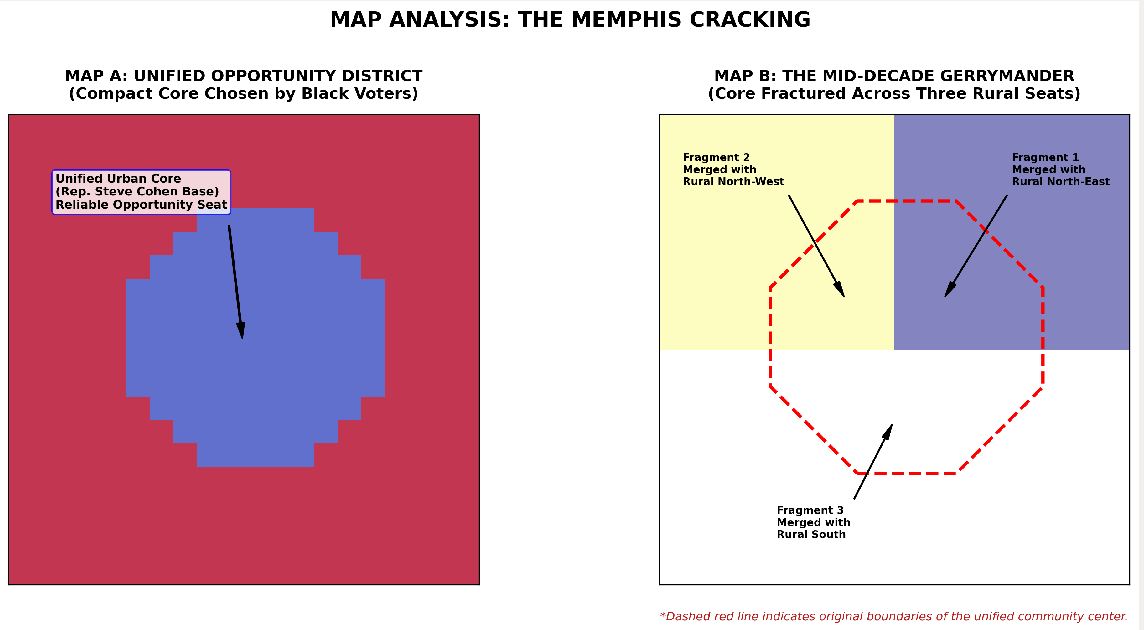
But the deeper, uglier truth of May 2026 is that the incumbency lifeboat is a mirage, discarded the moment it conflicts with white partisan optimization. Look at what happened this month in Memphis, Tennessee. For over half a century, the city’s Ninth Congressional District has stood as an unassailable bastion of Black political self-determination. Its modern legacy was forged in 1974 when Harold Ford Sr. won a historic, hard-fought victory to become the first African American to represent Tennessee in the U.S. House—and one of the very first Black congressmen elected from the South since Reconstruction. Crucially, Ford Sr. carved out this path before the protective armor of the 1982 Section 2 amendments even existed.
That seat became a foundational pillar of Southern civic power, held by Ford Sr. from 1975 to 1997, and passed to his son, Harold Ford Jr., who served from 1997 until launching a historic U.S. Senate bid in 2007. In the post-Ford era, this compact, majority-Black electorate continued to exercise its structural autonomy by consistently electing Congressman Steve Cohen as their chosen representative. Though Cohen is white, he was indisputably the cohesive choice of Memphis’s Black voters.
By cracking this historic urban core in 2026, state mapmakers aren’t just engaging in routine political chess. They are cynically targeting a legacy of Black electoral power that predates modern voting rights jurisprudence itself—proving that no amount of historical permanence or cohesive cross-racial coalition-building is safe from structural erasure.
Yet, the moment the Tennessee General Assembly saw an opportunity to net a conservative seat, “incumbency protection” was thrown in the garbage. They sliced Memphis into three pieces, fracturing the Black electorate into white rural districts and forcing Cohen to terminate his campaign. As a defeated Cohen told the press on May 15, 2026: “I don’t want to quit… [but] these districts were drawn to beat me… These changes were done to get one more vote.”
Look at Mississippi, where Governor Tate Reeves and white conservative officials are openly moving to redraw the state’s political maps to target Congressman Bennie Thompson, the lone Black and lone Democratic representative in a state that is 38% African American. Thompson fired back to the press: “It’s obvious this is an effort to deny not just Democrats, but Black people an opportunity to pick the representatives of their choosing… Why would you want to deny representation by that 38%?”
The South Florida Collision: The Lifeboat as a Weapon
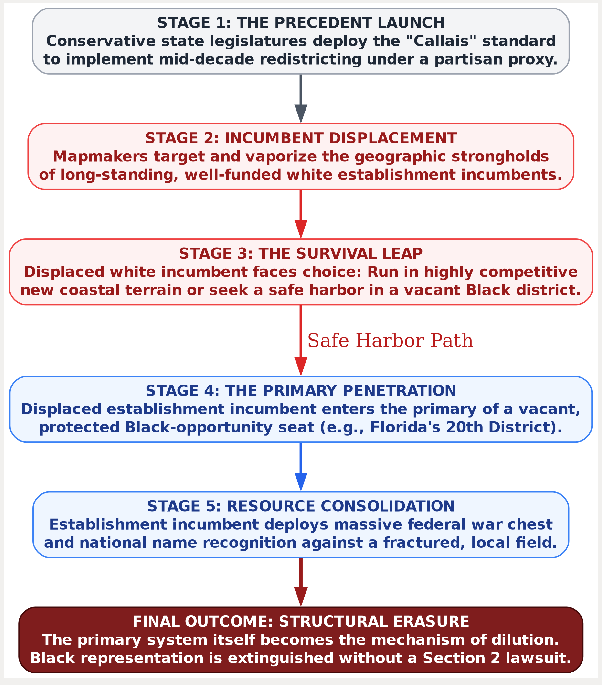
If Memphis and Mississippi show how the illusion of “incumbency protection” is discarded when it conflicts with a partisan power grab, the ongoing explosion in South Florida demonstrates a more insidious danger: how the intentional dismantling of white-incumbent districts forces a destructive collision within the Black electorate.
Following the Callais precedent, Governor Ron DeSantis signed an aggressively redrawn mid-decade congressional map into law. The map systematically vaporized the traditional Broward County base of veteran white Democratic incumbent Debbie Wasserman Schultz, leaving her politically displaced ahead of the candidate qualifying deadline.
Faced with the sudden erasure of her district, Wasserman Schultz announced her intention to seek re-election, creating a calculated, devastating dilemma. Rather than fighting in a newly configured, highly competitive coastal seat, the geographic reality forces her to consider utilizing her immense federal war chest and name recognition to seek a safe harbor in Florida’s 20th Congressional District (FL-20).
FL-20 is the historical soul of Black political representation in South Florida, formerly held by the legendary Alcee Hastings. Left vacant by a recent resignation, a crowded field of local Black Democratic primary candidates—possessing deep community roots but lacking federal incumbency—had already stepped forward to run.
The threat of a high-profile, non-Black establishment incumbent entering the FL-20 primary triggered a sharp, defensive resistance. The Democratic Black Caucus of Broward County took the extraordinary step of issuing an urgent public statement, pleading with Wasserman Schultz not to cannibalize the seat:
“Florida’s 20th is the first vacant Black-opportunity district to face a primary in the post-Callais era… If a non-Black incumbent can come into a vacant Black-opportunity district, consolidate against a fractured Black field, and win, every other Black-opportunity district in the South that loses its incumbent becomes available to the next displaced non-Black incumbent the same way.”
This is the ultimate evolution of the trap. By passing maps that intentionally displace powerful non-Black incumbents, conservative mapmakers force an artificial, zero-sum survival game, driving those incumbents directly into the remaining Black-opportunity zones. The primary itself becomes the mechanism of erasure, neutralizing a Black district without ever having to trigger a Section 2 lawsuit.
A Leaderless Vanguard: The Mandate for Absolute Unity
The timing of this existential crisis could not be more perilous. The recent death of civil rights titan Reverend Jesse Jackson has left a profound void in the national consciousness. For over fifty years, Jackson stood as a formidable, singular voice capable of commanding a national microphone, mobilizing millions, and orchestrating a cohesive coalition of Black leaders, activists, and international allies to defend the hard-won gains of the Voting Rights Act.
Without his thunderous rallying cry to anchor the resistance, the African American community faces a dispersed and fractured battlefield. The contemporary vanguard has sounded the alarm, but the struggle demands an unprecedented, unified consolidation of voice to cut through the noise.
Civil rights attorney Sherrilyn Ifill laid bare the stakes, warning that the Supreme Court has essentially hollowed out our safety mechanisms, pushing the standard back to an unwinnable bar. “Intent is hard to prove. Impact is easier to measure,” Ifill observed, pointing out that by shifting the legal focus away from real-world discriminatory effects, the Court has willfully made “the geography of voting power tied to the geography of segregation.”
Kristen Clarke, general counsel of the NAACP, directly labeled the Court’s structural undoing as an intentional invitation for historical regression. “The court has essentially put the death knell into our nation’s most singularly important federal civil rights law,” Clarke stated, noting that the ruling has explicitly emboldened lawmakers in former slaveholding states to aggressively dismantle majority-Black districts.
Congressional Black Caucus (CBC) Chair Yvette Clarke characterized the sudden wave of map overhauls as a systemic attempt to decimate the historic high of 62 Black members on Capitol Hill. Speaking on the sweeping nature of this coordinated offensive, Chairwoman Clarke called the developments a “devastating blow” meant to fundamentally disrupt the key structures of Black political growth.
Even veteran leaders who once believed in transactional, stable compromises recognize that the baseline of survival has been breached. Senior Congressman Jim Clyburn of South Carolina, whose own historic district faces a dismantling proposal modeled on the Callais ruling, fiercely called the state’s sudden, aggressive Republican mapping offensive “a comprehensive approach to creating Jim Crow 2.0.”
A Call to the Resistance: Winning on Rigged Terrain
If the Supreme Court’s trajectory from Shelby County (2013) to Callais (2026) proves anything, it is that the federal judiciary is no longer a sanctuary for civil rights. The resistance against the Third Counter-Reconstruction must move on three urgent fronts:
- The Wall of State VRAs: We must launch aggressive campaigns to pass State Voting Rights Acts, mirroring the robust frameworks of New York and California. By codifying the “Results Test” directly into state statutes, we can establish ironclad protections in state courts that conservative federal judges cannot touch.
- Voting as a Defense: We must reframe the ballot from an abstract civic duty to an act of survivalist defense. History shows that mass, disciplined voter turnout can completely overwhelm the mathematical calculations of a gerrymander. Turnout can burst the seams of the cage.
- A Supreme Court-Proof John Lewis VRA: Our federal legislative objective must be absolute. We must demand a federal John Lewis Voting Rights Act specifically designed to be “Supreme Court-Proof,” explicitly codifying the “Results Test” into permanent statutory text and stripping the Court of the ability to enforce an un-winnable “intent” standard.
Conclusion: A Requirement of Democracy
The Louisiana v. Callais decision is a loud, ringing siren. If we do not treat this moment as an existential emergency, we are headed back to an era where Black Americans possess the theoretical right to cast a ballot, but are stripped of the structural power to lead.
Thirty years ago, working alongside Alabama Legislative Black Caucus Chair George Perdue in Montgomery, and serving as the technical advisor to the entire Georgia Legislative Black Caucus during the explosive 1995 Special Session—where we analyzed the immediate, destructive aftermath of Miller v. Johnson in Atlanta—I watched the first wave of this modern backlash break over the South. Today, the tools are more sophisticated, the data is sharper, and the courts are far more hostile, but the structural target remains identical.
The presence of Black voters and their chosen leaders in the halls of power is not an “option” to be bartered away for partisan advantage, and it is not a constitutional “injury” to be remedied by a colorblind court. It is a fundamental requirement of American democracy. And if the courts will not defend it, the masses must.
To better understand the immediate, localized fallout of these mid-decade changes on minority representation, you can watch Rep. Debbie Wasserman Schultz speaking out after the redistricting vote, which exposes the raw, partisan overreach targeting these historic boundaries firsthand.
To better understand the immediate, localized fallout of these mid-decade changes on minority representation, you can watch Rep. Debbie Wasserman Schultz speaking out after the redistricting vote. This local broadcast captures the direct political tension in Broward County immediately following the implementation of the new Florida maps.
May 18th, 2026
About The Author