Judicial Overhauls, Executive Power Grabs & Voting Rights Quiz
Do You Understand the New Architecture of Power?
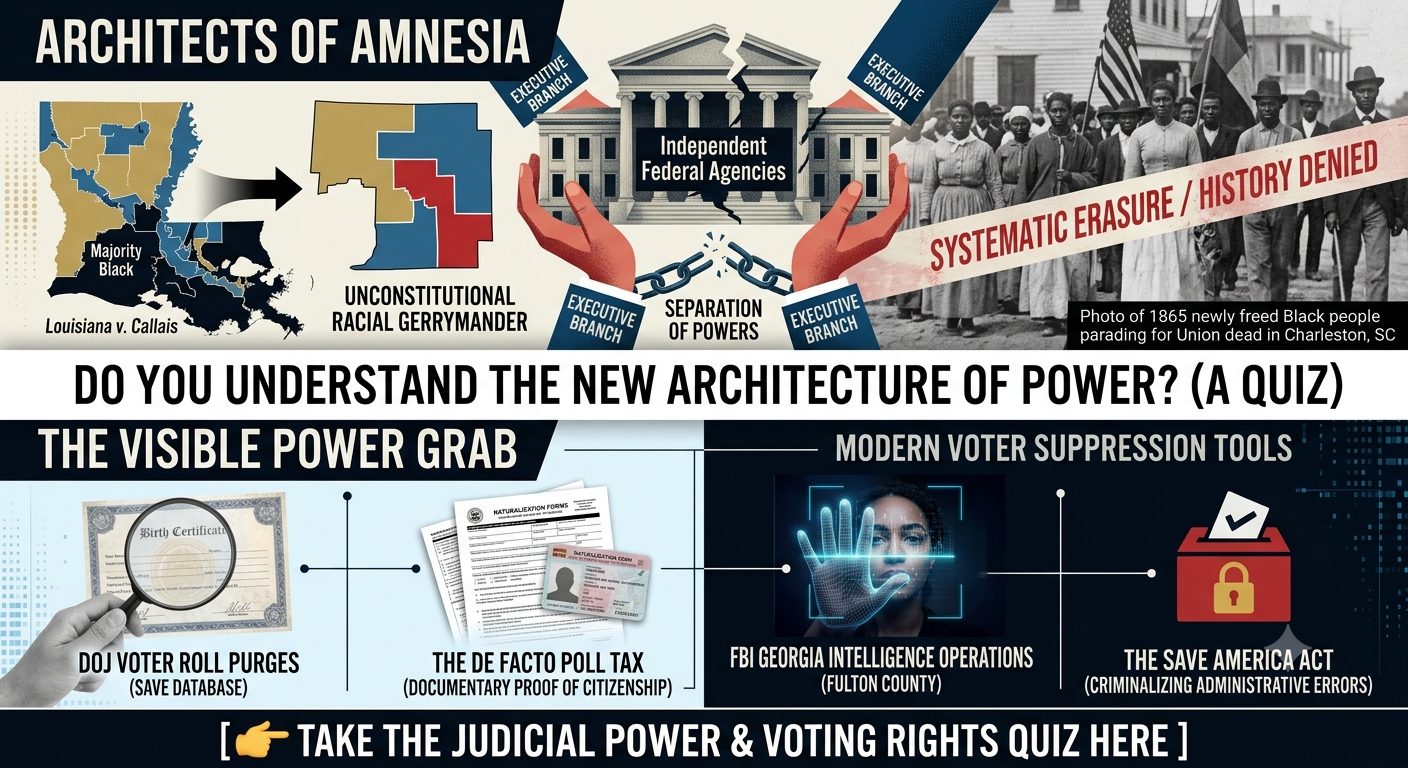
From local ballot boxes to the highest halls of federal governance, the rules of American democracy face a hostile structural takeover in the summer of 2026. Take this interactive executive overreach and Voting Rights Quiz to see if you can spot the unprecedented power grabs being attempted through the SAVE America Act, recent landmark judicial overhauls, quiet legislative maneuvers, and now, an upcoming prime-time presidential address.
If you’ve been watching the news over the last few months, you know something fundamental has shifted in the US. But when we consume the news in isolated fragments, it’s easy to miss what has happened.
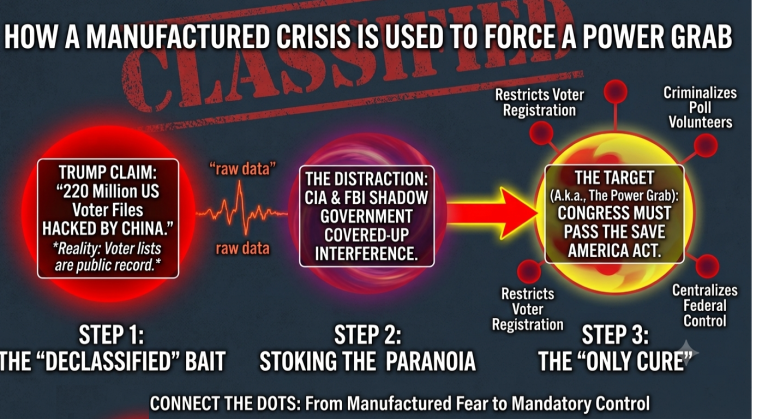
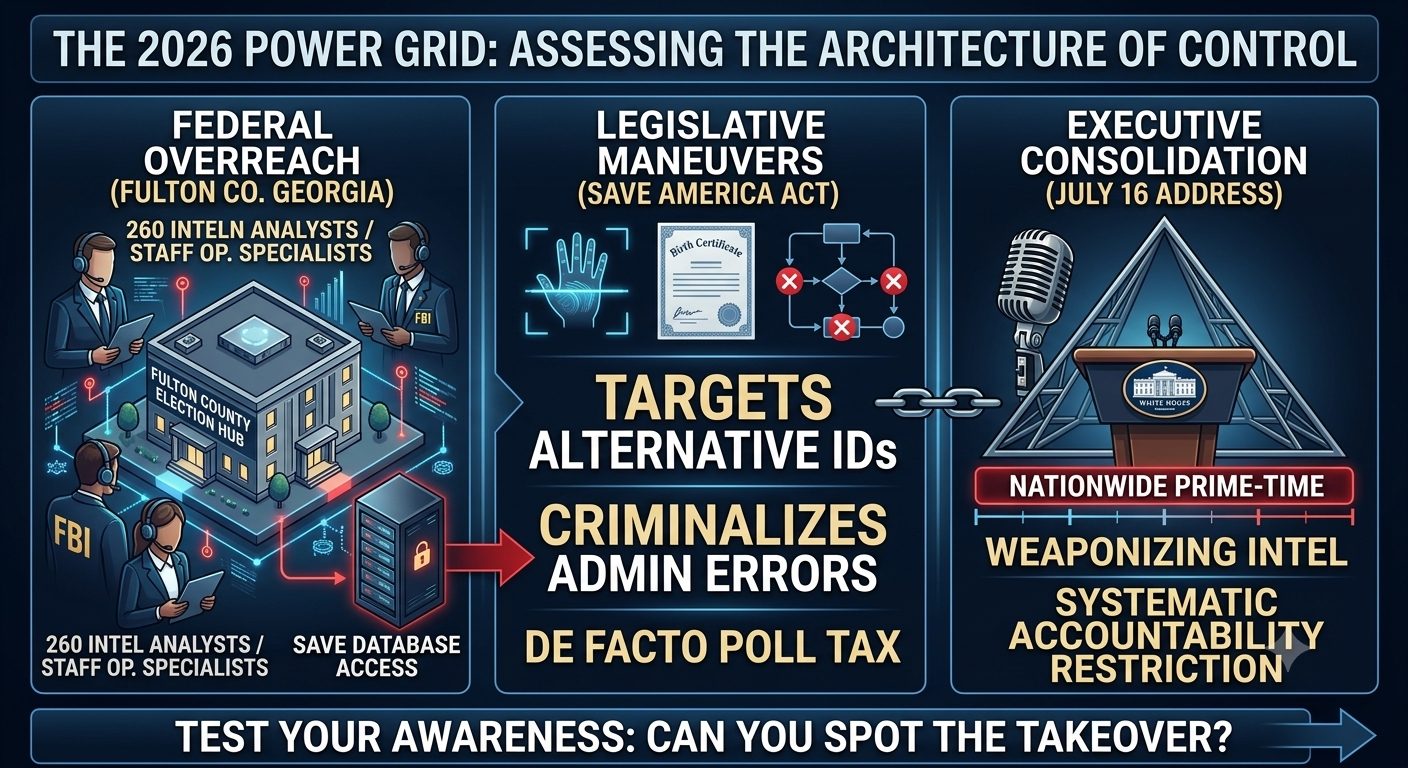
We see 260 FBI intelligence analysts and staff operations specialists sent to majority-Black Fulton County (Atlanta), Georgia. We see the White House lining up a major prime-time national address this Thursday, July 16, 2026, to weaponize newly declassified intelligence on the 2020 election, as reported by Reuters. We also see the President let a popular bipartisan housing bill pass into law without his signature in protest because Congress won’t pass the so-called SAVE America Act—a measure that criminalizes administrative errors by voter registrars and targets alternative IDs, systematically pricing vulnerable communities out of the ballot box.
You have to ask yourself: What is really going on in our country?
To answer that, we’ve put these critical developments together in the form of a diagnostic quiz. This quiz tests your knowledge of the aggressive restrictions to voter access being attempted and implemented in plain sight and tracks how and where power is being consolidated. It also asks you about some monumental corporate and economic shifts of mid-2026—from executive directives reshaping the single-family housing market to the sweeping, historical dilution of voting rights and consolidation of political control authorized by the Supreme Court’s landmark rulings.
Are these detached political developments, or are they part of an overall effort to fundamentally change who gets elected, how votes are counted, consolidate unprecedented executive power, and restrict the federal government’s public accountability?
Test your knowledge of these rapid-fire structural changes.
[👉 Take the Judicial Overhauls, Executive Power Grabs & Voting Rights Quiz here]
Test your knowledge, read the comprehensive deep-dive explanations behind each answer, and drop your score in the comments below the article introduction on Substack.
Note: Due to the interactive layout, the quiz must be taken here directly on the main Black Politics website. However, comments are completely closed here—so once you finish and get your score, go over Black Politics on Substack to drop your results, share your thoughts, and join the discussion! Let’s see who has been paying close attention.
#1. Under the SAVE America Act, what must an eligible citizen present to register to vote in a federal election? ? Correct! The SAVE America Act requires voters to present physical Documentary Proof of Citizenship (DPOC)—such as a U.S. passport, birth certificate, or specialized government ID—in person just to register or update their voting address. Standard items like utility bills, bank statements, or a Social Security number alone would no longer suffice.
The act completely eliminates traditional registration pathways like simple mail-in forms, online registration portal matching, and community drives that rely on standard voter affidavits. Instead, it mandates strict Documentary Proof of Citizenship (DPOC)—such as an unexpired U.S. passport or a certified birth certificate.
#2. How does the SAVE America Act require voters to submit their registration documentation? ? Correct! Under the SAVE America Act, voters are generally required to present their physical Documentary Proof of Citizenship (DPOC) in person to an election official. Because of this strict in-person requirement, the bill effectively upends online registration (used by 42 states) and traditional mail-in registration, as applications cannot be completed without physically delivering the original documents to an election office.
The law heavily restricts remote and electronic verification methods, generally requiring voters to bring physical, original documents to centralized county or local election offices in person. This creates a severe logistical barrier for working-class and Black voters who face rigid job hours, lack paid time off, or do not have reliable transportation to distant county seats.
#3. If a federal law were to require a strict birth certificate or passport mandate to register, why would this create an immediate historical barrier for older African American voters? ? Correct! For older African Americans, particularly those born in the Jim Crow South, a strict birth certificate or passport mandate creates a massive historical barrier. Due to systemic discrimination, segregated hospital policies, and the prevalence of home births attended by informal midwives during that era, many older Black citizens were never issued official birth certificates. Requiring these document types effectively locks out a generation of eligible, lifelong voters.
For generations of Black Americans born in the rural, segregated South before the mid-1960s, systemic exclusion from hospitals meant many were delivered at home by midwives. Consequently, official state birth certificates frequently do not exist for them. Over 21 million eligible U.S. citizens lack immediate access to these documents, and correcting this requires complex, expensive legal actions.
#4. Because obtaining required official documents often involves paying state or federal fees, civil rights attorneys argue that such a mandate functions as: ? Correct! Because obtaining official documents like birth certificates or passports almost always requires paying state or federal government fees, civil rights attorneys argue that this mandate functions as a modern-day poll tax. Under the 24th Amendment, charging any fee—directly or indirectly—as a requirement to register or vote is unconstitutional.
Under the Twenty-Fourth Amendment, charging a citizen money to access the ballot box is unconstitutional. Because a voter must spend between $15 to $165 to obtain the specific federal or state documents required to register under this act, critics argue it acts as a modern-day poll tax that disproportionately prices out low-income and working-class communities.
#5. Under the current federal administration, what has the DOJ (Department of Justice) Voting Section prioritized as its primary operational directive? ? Correct! Under the current administration, the DOJ's Voting Section has shifted its primary directive to focus aggressively on election integrity, voter roll maintenance, and enforcing citizenship verification. This operational pivot deprioritizes traditional voting rights discrimination cases under Section 2, focusing instead on auditing statewide voter registries, seeking out noncitizen registration, and ensuring voter rolls are purged.
The DOJ Civil Rights Division has completely inverted its historical role as an ally to civil rights groups. Rather than using the law to protect voters from suppression, the Voting Section is aggressively suing states to seize voter rolls and running them against federal databases to force rapid-fire list maintenance. This results in high rates of false positives where eligible Black voters with common surnames are mistakenly kicked off the rolls.
#6. Under the proposed mandates of the SAVE America Act, what criminal penalty would a local clerk or volunteer face for processing a voter registration form that lacks the exact required citizenship paperwork? ? Correct! Under the SAVE America Act, state and local election officials, clerks, or registrars could face up to five years in prison—and even face private civil lawsuits—for registering an applicant who does not provide the exact, required physical proof of citizenship. This criminal liability applies even in cases of simple administrative human errors or if the applicant is indeed a eligible U.S. citizen.
The act criminalizes routine administrative oversights, threatening local clerks and community volunteers with felony charges and prison time—even if the person they registered is an eligible U.S. citizen. This creates a massive chilling effect, causing local offices to reject applications over minor typos and shutting down community voter drives entirely out of fear of liability.
#7. Which of the following forms of government-issued photo identification would fail to qualify as acceptable proof of citizenship for registering to vote under the strict rules of the proposed SAVE America Act? ? Correct! Standard state driver's licenses, public university student IDs, VA veteran health cards, and government employee badges all fail to qualify as proof of citizenship on their own. Because standard driver's licenses are issued to both citizens and non-citizens, they do not verify citizenship status and would have to be paired with secondary physical documents like a birth certificate or passport.
Most voters assume that any official, government-issued photo card is definitive proof of eligibility. Under the statutory text of the SAVE America Act, this is a dangerous misconception. The bill strictly amends federal law to require “Documentary Proof of United States Citizenship” (DPOC) at the time of voter registration.
Under these strict federal guidelines, standard state university student IDs and government-issued public assistance cards are completely excluded as valid proof. Even though these cards are issued directly by public universities and state government entities, they do not verify or denote citizenship status. This exclusion creates an immediate hurdles for younger voters and low-income citizens who rely on these forms of ID, forcing an unprecedented reliance on unexpired passports or official birth certificates just to get on the voter rolls.
By contrast, the Act explicitly outlines pathways for other forms of ID: state driver’s licenses are accepted if the state’s issuing process requires citizenship verification, and U.S. military IDs are accepted when accompanied by a supporting military record showing a U.S. place of birth.
#8. The primary legislative target of the SAVE America Act is a historic civil rights law that first established uniform federal voter registration standards. Which of the following laws does the bill explicitly aim to amend and weaken? ? Correct! The SAVE America Act explicitly aims to amend and weaken the National Voter Registration Act of 1993 (NVRA), commonly known as the "Motor Voter" law. By replacing the NVRA's original "attestation under penalty of perjury" standard with a strict physical documentation mandate, the bill systematically dismantles the simplified, uniform registration pathways established by this landmark legislation.
Passed in 1993 after years of relentless organizing by grassroots voting rights advocates, the National Voter Registration Act (NVRA)—popularly known as the “Motor Voter” law—was designed to dramatically expand ballot access by requiring states to offer voter registration at motor vehicle agencies, public assistance offices, and through accessible mail-in forms. The SAVE America Act directly dismantles this foundational framework by substituting the NVRA’s standard signature attestation clause with a mandatory, in-person “show your papers” documentary proof requirement. For those who fought to establish the NVRA in the early 1990s, this represents a sweeping attempt to roll back decades of hard-won registration access and return to an era of localized administrative exclusion.
#9. To execute the aggressive voter roll purges prioritized by the administration, a 2026 Executive Directive ordered federal agencies to cross-reference state voter data with which federal database? ? Correct! The 2026 Executive Directive ordered federal agencies to cross-reference state voter rolls with the Department of Homeland Security’s SAVE (Systematic Alien Verification for Entitlements) database. Critics and election experts heavily criticize this directive because the SAVE system was designed to verify eligibility for government benefits—not voter registration—leading to a high rate of "false positives" that mistakenly flag naturalized U.S. citizens as non-citizens.
The Executive Directive mandated that local voter rolls be run against massive federal citizen and non-citizen databases. Voting rights advocates note this creates a high rate of “false positives,” where eligible citizens with common minority surnames or minor typos are flagged as anomalies and rapidly purged from active voting registries without adequate notice.
#10. In July 2026, the White House announced a national address regarding newly declassified intelligence on the 2020 election. Critics argue that by highlighting alleged “voting machine vulnerabilities,” the administration’s focus on foreign interference is primarily designed to: ? Correct! Critics and election security experts argue that by highlighting these alleged vulnerabilities and casting the 2020 election as illegitimate, the administration is primarily trying to lay the political groundwork to challenge future Democratic victories in the 2026 midterms. They also argue it serves as a legislative predicate to pressure Congress into passing the restrictive SAVE America Act and to justify executive overreach—such as expanded federal oversight of state-run election systems.
🔍 Behind the Answer
On July 13, 2026, details emerged that the administration plans to utilize newly declassified intelligence reports to assert that foreign adversaries targeted “voting machine vulnerabilities” during the 2020 election.
While the administration frames this as a necessary step to protect national security and expose foreign cyber threats, election law experts and civil rights advocates point to a deeper structural motive. For over a year, the administration has sought to increase federal control over local election administration. Utilizing national security intelligence to label state-run voting machines as “vulnerable” provides a powerful justification to bypass the Constitution’s traditional delegation of election authority to the states, paving the way for sweeping, centralized federal oversight just ahead of the 2026 midterms.
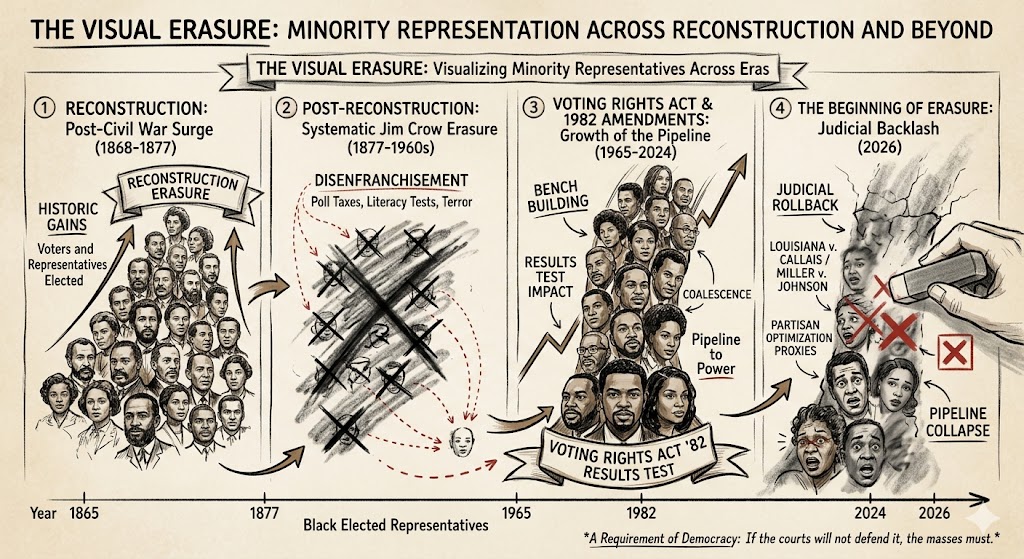
#11. By ruling that Section 2 of the Voting Rights Act only applies when there is a strong inference of intentional racial discrimination, the Court’s decision in Louisiana v. Callais effectively revived the rigid legal standard of which Supreme Court precedent? ? Correct! By making proof of intentional discrimination a central hurdle for Section 2 claims, the Court’s decision in Louisiana v. Callais effectively revived the highly restrictive legal standard from City of Mobile v. Bolden (1980). Congress had explicitly amended and overturned this "intent" requirement in 1982 to establish a "results-based" test, which this ruling heavily rolls back.
In 1980, the Supreme Court ruled in Mobile v. Bolden that plaintiffs had to prove a discriminatory intent to strike down voting laws. To protect civil rights, Congress stepped in and explicitly amended the Voting Rights Act in 1982 to establish a “results” standard. Four years later, in the landmark 1986 case Thornburg v. Gingles, the Supreme Court officially codified those 1982 amendments by establishing a clear framework that allowed courts to strike down maps based purely on their discriminatory effects.
Under this Gingles standard, civil rights lawyers could successfully force states to draw majority-Black districts by meeting a simple, three-part objective test:
-
Is the minority group large and geographically compact enough to form a majority in a district?
-
Is the minority group politically cohesive (meaning they tend to vote for the same candidates)?
-
Does the white majority vote as a bloc to defeat the minority group’s preferred candidate?
In Louisiana v. Callais, the Court’s 6-3 majority effectively neutralized the 1982 amendments. By forcing plaintiffs to once again prove a strong inference of intentional racial discrimination rather than just meeting the objective, effects-based Gingles test, Callais strips away 40 years of legal protection. It pushes voting rights jurisprudence directly back to the hurdles of the Mobile v. Bolden era—making it incredibly difficult to legally challenge modern gerrymanders that systematically dilute Black voting power.
#12. What was the core ruling in Trump v. Slaughter, and how does it affect independent federal agencies like the Federal Trade Commission (FTC), the National Labor Relations Board (NLRB), and the Securities and Exchange Commission (SEC)? ? Correct! In Trump v. Slaughter (2026), the Supreme Court officially overruled the 90-year-old precedent Humphrey’s Executor v. United States (1935). The Court ruled that "for-cause" removal protections are unconstitutional, giving the President absolute, unilateral power to fire commissioners of independent agencies like the FTC, NLRB, and SEC at will. This effectively ends the historical independence of these regulatory bodies, tying their policy-making and enforcement directly to the sitting President's agenda.
In a massive 6-3 decision, the Supreme Court explicitly overturned the 1935 precedent Humphrey’s Executor v. United States. By declaring for-cause removal protections unconstitutional, the Court dismantled a century of agency independence. While a companion ruling (Trump v. Cook) narrowly preserved protections for Federal Reserve governors like Lisa Cook due to the historical tradition of monetary independence, the Slaughter ruling completely weaponizes presidential control over the rest of the federal regulatory apparatus.
Critics argue this power is dangerous because it allowed for the immediate, unprecedented ousting of independent officials—such as Federal Trade Commission (FTC) Commissioners Rebecca Slaughter and Alvaro Bedoya, National Labor Relations Board (NLRB) Member Gwynne Wilcox, and Equal Employment Opportunity Commission (EEOC) leaders—purely because their regulatory and workplace enforcement priorities didn’t align with the White House. This effectively converts historically neutral watchdog panels into direct instruments of the executive branch’s political agenda.
#13. The bipartisan 21st Century ROAD to Housing Act, which officially became law in July 2026 without the President’s signature, includes a historic provision titled “Homes are for People, Not Corporations.” To protect individual homebuyers, this new law: ? Under Title X of the newly enacted 21st Century ROAD to Housing Act, the "Homes are for People, Not Corporations" provision prohibits large institutional investors (defined as for-profit entities with investment control over 350 or more single-family homes) from purchasing any additional single-family homes. Violations carry civil penalties of up to $1 million per violation or three times the purchase price, whichever is greater.
🔍 Behind the Answer
The 21st Century ROAD to Housing Act (H.R. 6644) officially became law on July 11, 2026, via a rare constitutional default: the President neither signed nor vetoed the bill, allowing it to automatically pass after 10 days on his desk. Title 10 of the act contains an aggressive bipartisan provision to rein in corporate landlords by targeting “Large Institutional Investors” (LIIs)—defined as any commercial entity or business arrangement controlling 350 or more single-family properties.
Under the new law, these mega-investors are completely prohibited from acquiring any additional single-family housing stock. While the law carves out exceptions for “build-to-rent” planned communities or deep “renovate-to-rent” neighborhood improvements, it attaches a strict ticking clock: corporate entities utilizing these exceptions must divest and sell the properties to individual homebuyers within seven years.
When it is time to sell, the landlord must provide the current renter with a 30-day “first-look” right of first refusal to buy the home. Any corporation found out of compliance faces massive civil penalties equal to $1 million or three times the property’s purchase price, whichever is greater.
Results


About The Author