What Republicans Are Trying to Pull in Redistricting Georgia
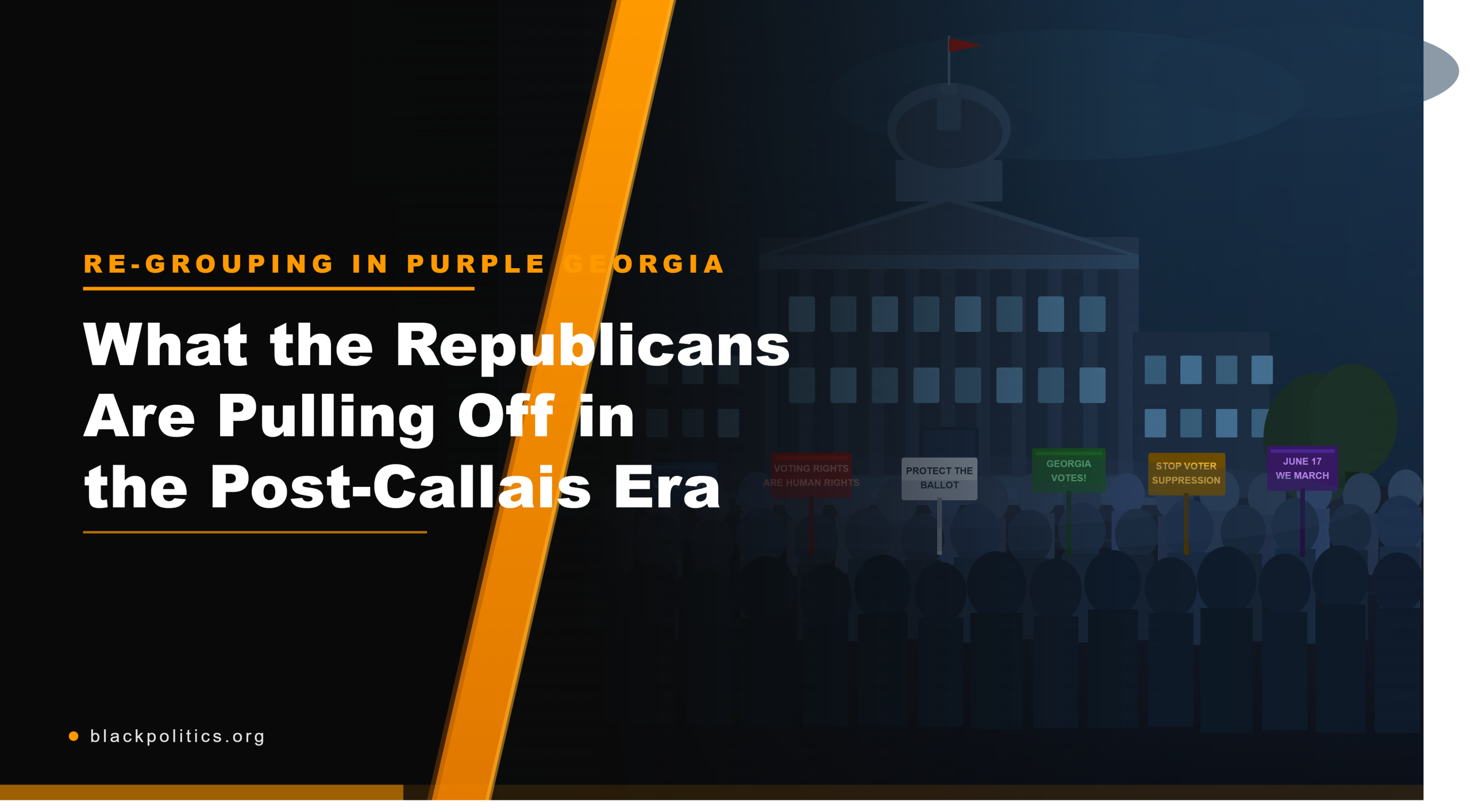
Voting rights activists protest at the State Capitol as Republican leaders navigate the post-Callais landscape of redistricting Georgia.
🚨 Editorial Update: The Post-Callais Crisis Shifts to Georgia
Voting rights activists won a temporary victory, but the fight has just begun. Discover what Republicans are trying to pull in redistricting Georgia for 2027. This expanded commentary serves as an essential companion piece to our deep-dive analysis on Louisiana v. Callais and the Erasure of Black Political Power, exposing how the High Court's newly revived intent standard has triggered a synchronized, multi-state blueprint to structurally dismantle Black representation across the American South. Read the full regional breakdown below.
By Steve Suitts
Special to blackpolitics.org
Civil rights and voting rights activists organized an impressive public protest at the special session of the Georgia General Assembly on June 17, and Republican legislative leaders balked. They postponed gerrymandering maps to reduce the state’s number of majority Black Congressional districts until next year’s regular session, which begins early January. It was a textbook example of how organizing and participating in strategic action can work. But it also means the fight has only begun.
Freed by the US Supreme Court’s Callais decision gutting the Voting Rights Act, Georgia’s Republican leaders have not retreated. Instead they are re-grouping and developing new strategies and opportunities to take full advantage of the Court’s ruling. Therefore, understanding their strategies is critically important for developing and sustaining future counter strategies to prevent or minimize their successes. Here’s what has happened and will likely happen as Republicans aim to sharply reduce the opportunity of minority citizens in Georgia to elect the candidates of their choice.
🚨 Essential Reading: How the Court Killed the Voting Rights Act – By Steve Suitts
In a profound new essay for Southern Spaces, legendary voting rights strategist and author Steve Suitts delivers an unsparing, definitive analysis of the U.S. Supreme Court’s systematic dismantling of democratic protections in the American South. Tracking decades of judicial hostility culminating in the catastrophic erosion of the Voting Rights Act, Suitts issues an urgent clarion call to organize, resist, and rebuild the foundation of our democracy.
What Has Happened So Far
Since Georgia’s early voting in 2026 primaries began as the Supreme Court issued its Callais opinion, the Georgia Republican legislature had no chance to gerrymander Congressional maps for this year. So, despite the calling of a special session, there was no need for Republican legislators to rush the maps since the earliest new districts can take effect only in 2028. Faced with protests and huge media attention, Republicans saw that they were running a risk of making redistricting one of the top issues in this November elections and motivating Democratic turnout in their own legislative elections this year. So they had every reason to postpone and deny Democrats an effective organizing issue this November.
Republican Governor Brian Kemp also had no reason to object strongly to the postponement. He called the special session to keep on the good side of the administration, but now he will have no political liability for what the legislature may do – or not do – in passing new maps since he will be out of office when they do act in 2027. As a possible 2028 presidential candidate, Kemp is staking out the political territory of being a party-compliant Republican who is not governed in all things by the national platform. It is the political posture of having it both ways that he has maintained in the state and will try to continue to project as he explores a presidential bid. So, the postponement suits Kemp’s political goals just fine.
What May Happen in Redistricting Georgia (2027-2028)
Here is what the Republicans are probably hoping will happen in 2027. In the regular session that runs from January into May, the Republican legislature will consider and debate many important, divisive issues of which redistricting will be only one. So, voting rights no longer will be the sole issue or the singular focus of lobbyists, the public, and the media.
In addition, the optics for Republican gerrymandering will look much better in 2027 than they do in the summer of 2026 when Republicans in other Deep South states have created a frenzy for eliminating majority Black districts. Remember, too, there will be no elections for a state or federal office in 2027, and anyone who opposes the Republican’s misdeeds and gerrymandered maps will have to wait 18 months in which to make it an issue that influences the November 2028 election.
Perhaps just as important for their strategy, by waiting until 2027 Republicans get to draw Congressional maps and the boundaries of their own state legislative districts in such a way to eliminate any gains that Democrats may make in this year’s November election. As a result, Republicans can run in 2028 in newly-redistricted, safer Republican districts with the least possible political fallout from reducing minority voting strength through gerrymandering.
Finally, the Republicans also know that if Democrats are able to win the governor’s race this November, Kemp can call a special session while he is still in office in December to allow the Republicans to pass gerrymandered maps and prevent a Democratic governor from vetoing such legislation in 2027.
📺 Featured Video Analysis
For an immediate legal and political breakdown of the special session retreat, watch voting rights attorney Marc Elias outline why the Republican leadership abruptly walked away from the legislative maps on June 17.
📌 The Takeaway
The takeaway is simple: Public protest and participation work to prevent injustice, but only if they are sustained. Georgia’s voting rights advocates won a battle on June 17, but the war over redistricting Georgia for 2028 is only beginning. Staying informed and organized over the next 18 months will be crucial to stopping the next wave of Republican gerrymandering.
An adjunct with Emory University's Institute for the Liberal Arts, Steve Suitts is the author of A War of Sections: How Deep South Political Suppression Shaped Voting Rights in America (Athens: NewSouth Books, 2023). Earlier in his career, Suitts worked as founding director of the Alabama Civil Liberties Union, executive director of the Southern Regional Council (when he was involved in the renewal of the 1965 Voting Rights Act and passage of the Motor Voter Act), and vice president of the Southern Education Foundation.
About The Author

Black Politics Newsroom
author
The Black Politics Newsroom curates timely, relevant, and mission-aligned content from trusted sources across the country. This editorial stream amplifies Black political discourse, tracks policy developments, and surfaces stories that shape our collective future. The original source for all curated articles is always listed at the end of each post, allowing readers to identify the original author and publication.