Introduction
Below is a verified executive orders 2025 scorecard tracking executive orders, federal troop deployments, and constitutional challenges in Black-majority and other cities ahead of the 2026 elections. The decisions of the White House have a direct impact on African American, African, and Caribbean communities across the United States. To help track these impacts, we maintain an Executive Orders 2025 Accountability Scorecard that reviews key executive orders, policy shifts, and initiatives from the current administration.
This Executive Orders 2025 Scorecard evaluates:
- Domains of policy (e.g., DEI, immigration, higher education, policing)
- Specific executive actions and when they were issued
- Communities most affected
- Municipal-level consequences for cities with large African diaspora populations
- Impact ratings and scores to show whether policies are positive, negative, neutral, or mixed in their outcomes
How to use this Scorecard
- Sort or filter the table by domain, date, or score to explore specific areas of interest.
- Negative scores highlight policies that may harm Black and diaspora communities.
- Positive or neutral scores reflect initiatives that expand opportunity or carry little equity impact.
Together, this tool is designed to bring clarity and accountability to federal actions and their ripple effects at the local level.
🕒 Last updated: October 12, 2025
View the Scorecard
| Domain | Action (EO / Policy) | Date | Communities most affected | Impact | Municipal Impacts | Why it matters | Score |
|---|---|---|---|---|---|---|---|
| Government DEI | EO 14151 – “Ending Radical and Wasteful Government DEI Programs and Preferencing” (terminates DEI/“equity” offices, action plans, grants; directs rollback) | Jan 20, 2025 | African American (all agencies) | ❌ Negative | Cities lose access to federal DEI grants supporting local equity initiatives, workforce training, and minority business programs (e.g., Baltimore, Atlanta, Detroit). | Eliminates federal DEI infrastructure; weakens municipal ability to leverage federal equity funds. | -1 |
| Government DEI (implementation) | DOJ guidance to agencies implementing EO 14151 | Mar 21, 2025 | African American (all agencies) | ❌ Negative | DOJ warns city/state agencies to end DEI-linked programs in federally funded initiatives; chilling effect on local universities and nonprofits. | Accelerates rollbacks and creates compliance risks for local partners. | -1 |
| Federal contracting & jobs | EO “Ending Illegal Discrimination and Restoring Merit-Based Opportunity” (revokes EO 11246, affirmative action in federal contracting) | Jan 21, 2025 | African American workers & businesses | ❌ Negative | Cities with large minority contractor bases (e.g., New Orleans, Chicago, D.C.) face contracting uncertainty; municipal agencies may adjust procurement rules. | Removes long-standing federal equal opportunity clauses in contracts. | -1 |
| Defense workforce | Defense DEI rollback (DoD offices/programs ended) | Jan 2025 | Black service members, civilian DoD workforce | ❌ Negative | Cities with large military bases (e.g., Norfolk, Fayetteville) see loss of DEI programs supporting Black service members and families. | Reduces institutional support in military communities. | -1 |
| HBCUs | EO – “White House Initiative to Promote Excellence and Innovation at HBCUs” | Apr 23, 2025 | HBCU students & institutions | ⚠️ Mixed | Municipalities hosting HBCUs (e.g., Atlanta, Nashville, Washington, D.C.) may gain visibility but not new federal dollars; budget cut proposals (Howard) offset gains. | Coordination without guaranteed funding creates uncertainty. | 0 |
| Higher ed grants | Grantmaking overhaul (federal grant review/termination) | Aug 7, 2025 | Black students/faculty; HBCUs | ❌ Negative | Cities reliant on federal research/education funds (e.g., Durham, Jackson, Baton Rouge) face reductions in programs supporting minority students. | Freeze/termination disproportionately affects public/HBCU institutions. | -1 |
| Immigration (border & asylum) | EO: “Protecting the American People Against Invasion” + directives restoring hardline policies | Jan–Feb 2025 | African & Caribbean asylum seekers | ❌ Negative | Cities with growing African/Caribbean migrant populations (e.g., Miami, Houston, Minneapolis) see increased deportations, legal aid burdens, and shelter strain. | Reduces access to asylum; burdens local services. | -1 |
| Immigration (TPS) | Termination of TPS for Haiti (delayed by court) | Jul 1, 2025 | Haitian diaspora (Caribbean) | ❌ Negative | Miami, New York, Boston — Haitian communities face housing/employment instability as TPS expiration looms (Feb 2026). | Generates fear, labor disruption, and legal uncertainty in diaspora hubs. | -1 |
| Policing / deployments | Federalized Guard/federal deployments under “crime emergency” posture | Sep 2025 | Black neighborhoods; immigrant communities | ❌ Negative | Deployments challenged in court as unconstitutional and racially targeted; residents fear federal overreach and erosion of civil rights | Signals punitive federal-local intervention. | -1 |
| Architecture / culture | EO “Making Federal Architecture Beautiful Again” (revives 2020 order) | Aug 28, 2025 | Indirect | ◻️ Neutral | Cities hosting federal construction projects may see design restrictions, but no material community equity effect. | Cultural/administrative, limited direct impact. | 0 |
| Federal Workforce | Shutdown-triggered layoffs (Reduction in Force notices issued to over 4,100 federal workers) | Oct 10–11, 2025 | African American federal employees (disproportionate impact likely) | ❌ Negative | Cities with large Black federal workforces (e.g., D.C., Atlanta, Baltimore, Detroit) face economic strain, housing instability, and service disruption | Layoffs target agencies with high Black employment (HUD, HHS, Education); unions allege racial targeting and retaliation | -1 |
What’s Next?
The Executive Orders 2025 Accountability Scorecard is a living tool. Policies can change quickly, and new executive orders or initiatives may shift the impact on African American, African, and Caribbean communities.
We encourage readers, scholars, journalists, and community leaders to:
- Share feedback on how federal actions are affecting your city or community.
- Suggest additional policies that should be tracked here.
- Engage locally with organizations that advocate for equity and accountability in government.
Our goal is not only to inform but also to empower communities with knowledge, so that accountability reaches from the White House to every neighborhood
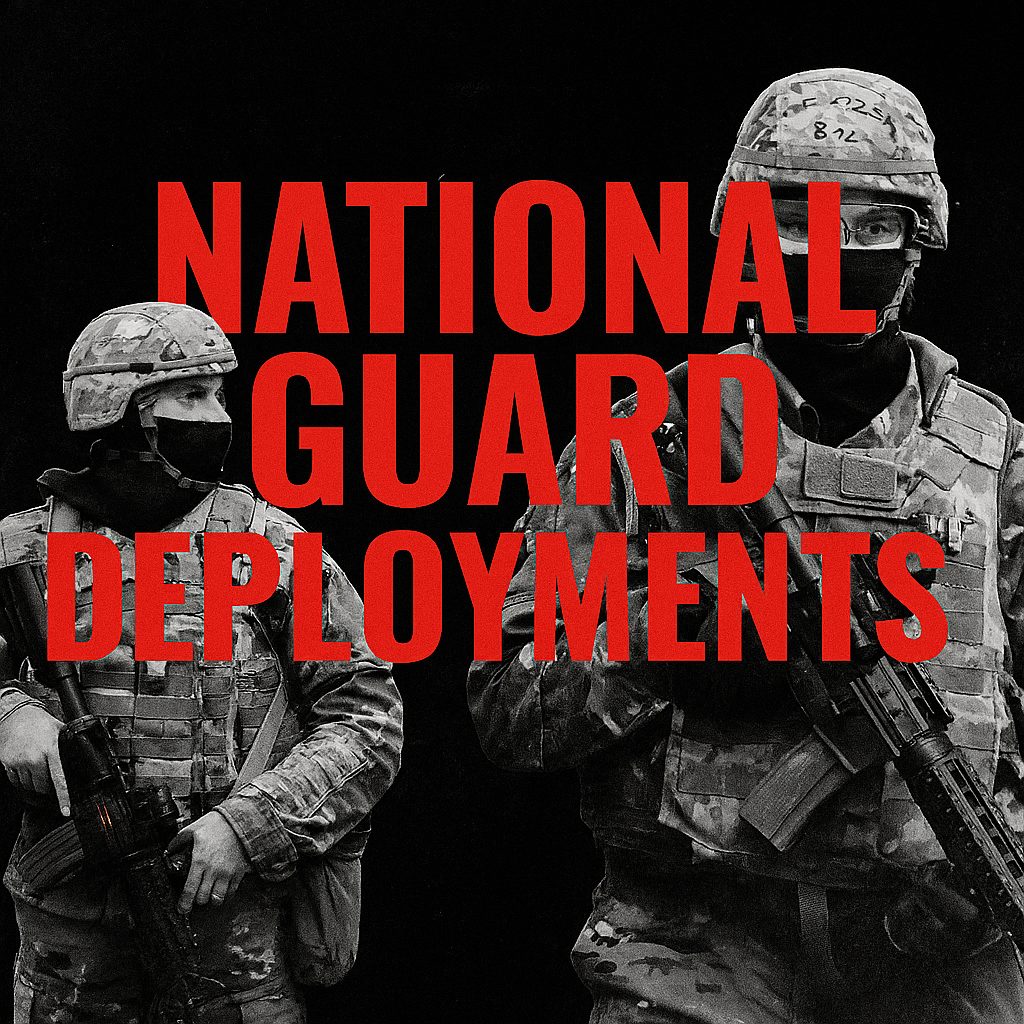
⚖️ National Guard Deployments under the Trump Administration: Constitutional Controversy and Electoral Risk
Federalized National Guard deployments of troops to majority-Black cities including Washington, D.C., Memphis, and the outskirts of Chicago, have often been over the objections of local mayors and governors. In Chicago, court orders have blocked direct deployment into the city proper, citing constitutional concerns and lack of credible threat. In Los Angeles, a majority non-white city, federal troops were deployed and later challenged in court. In Portland, Oregon, where protests centered around immigration enforcement and federal facilities, the deployment was temporarily blocked by a federal judge. The city of Portland, Oregon, is not majority Black.
These national guard deployments have drawn widespread criticism and legal challenges, with civil rights groups and state officials arguing that the actions were politically motivated, racially targeted, and unsupported by evidence of rebellion or unrest. Lawsuits in Illinois, Oregon, and California cite violations of the 10th and 14th Amendments, and warn of a dangerous precedent for executive overreach into local policing.
Click below to expand full analysis and footnotes ↓
🧠 Contextual Analysis: Executive Overreach and Voter Suppression Risk
Critics argue that the Trump Administration’s national guard deployments of federal troop — especially to cities with large Black and immigrant populations — risk provoking unrest among local residents, which could then be used as a pretext for further militarization. Legal scholars and civil rights groups warn that this tactic mirrors historical patterns of occupation and suppression, rather than legitimate public safety measures.
Illinois Governor JB Pritzker and others have accused the administration of manufacturing chaos to justify invoking the Insurrection Act, describing the deployments as a “military-style invasion” and a “power grab.”
Concerns have also been raised about the implications for the 2026 midterm elections, particularly if federal troops remain active or visible in urban centers during the voting period. Analysts from Democracy Docket and the Society for the Rule of Law warn that such deployments could intimidate voters, suppress turnout, and undermine the integrity of the electoral process — especially in communities already subject to surveillance and over-policing. The possibility of troops near polling places has sparked alarm among constitutional experts, who cite the Posse Comitatus Act and the Voting Rights Act as legal bulwarks against military interference in civilian democratic functions.
📌 Footnotes and Sources: Federal Troop Litigation and Accountability
- Multiple lawsuits filed in 2020 and 2025 challenged the legality of federal troop deployments in cities like Portland, Chicago, and Washington, D.C., citing violations of the 10th and 14th Amendments. See:
- The Brennan Center for Justice and the ACLU have documented concerns that these deployments lacked credible justification and disproportionately targeted Black-majority cities. See:
- Legal scholars argue that invoking the Insurrection Act without state consent or clear evidence of rebellion sets a dangerous precedent for executive overreach. See:
- Congressional hearings and civil rights testimony in 2020 raised questions about the political motivations behind these deployments, with experts highlighting racial bias and lack of transparency. See:
- Democracy Docket and the Society for the Rule of Law have raised alarms about the potential chilling effect of federal troop presence during elections, citing risks to voter turnout and democratic integrity. See: