Longform
How social movements, research, and community leadership reframed safety and fairness from the civil rights era to today.
Introduction
Criminal justice reform is no longer a niche policy conversation. It is an everyday question about how the United States understands public safety, accountability, and human dignity. Over the past half-century, Americans witnessed rapid expansions in policing, prosecution, and incarceration, followed by a surge of reforms informed by data and lived experience. This essay maps that evolution—highlighting lessons learned and the work ahead.
Pull-quote: “The opposite of mass incarceration is not mass release without support; it’s a system built on necessity, proportionality, and opportunity.”
From Civil Rights to Mass Incarceration
The 1960s civil rights movement exposed injustices in policing and courts, yet federal and state policy in the ensuing decades increasingly pursued punitive responses to social and economic challenges. Mandatory minimums, truth-in-sentencing, and three-strikes laws normalized extremely long sentences. The prison population grew from roughly 200,000 in 1970 to more than 1.2 million in state and federal prisons by the 2000s, with millions more in jails and community supervision.
Racial disparities persisted at every stage—stops, arrests, charging, conviction, and sentencing. Research from organizations such as The Sentencing Project, Vera Institute, and Prison Policy Initiative documented how policy choices—not simply crime trends—drove incarceration growth and disparities.
The Reform Turn
By the late 2000s, bipartisan reform coalitions emerged. States revised drug laws, expanded diversion and treatment, and reduced probation and parole revocations. Philanthropic, academic, and grassroots leaders advanced evidence-based alternatives and violence-interruption strategies. The Brennan Center, ACLU, and others supplied model policies and data tools; newsrooms like The Marshall Project elevated accountability journalism.
Policing also entered a new phase: use-of-force standards, crisis intervention, duty-to-intervene, and decertification reforms expanded, while transparency initiatives—open data on stops, force incidents, and discipline—grew across cities and states.
What Works (and What Doesn’t)
- Target the front end: Ending cash bail for low-risk cases, providing counsel early, and expanding pre-arrest diversion reduces jail churn without increasing crime.
- Scale credible alternatives: Behavioral health crisis teams, violence-interruption, and restorative practices can reduce harm and recidivism when funded and integrated.
- Reform sentencing with retroactivity: Shortening excessive terms and applying changes retroactively has safely reduced prison populations in multiple states.
- Invest in reentry: Housing, IDs, expungement, and employment pipelines are core safety strategies, not extras.
- Avoid policy whiplash: Isolated reforms without implementation capacity, data, and training rarely stick.
Blueprint for a Fair & Safe System
Policing
- Adopt necessity and proportionality use-of-force rules; require de-escalation and duty to intervene.
- Independent investigations for serious incidents; public disciplinary records; decertify for misconduct.
- Institutionalize crisis response alternatives and community oversight with real authority.
Prosecution & Courts
- Presumptions against prosecution for low-level nonviolent offenses; expand problem-solving courts.
- End cash bail; use validated tools with transparency and audits; ensure counsel at first appearance.
- Open file discovery; publish charging and plea data disaggregated by race and gender.
Sentencing & Corrections
- Eliminate mandatory minimums; expand judicial safety valves and second-look resentencing.
- Earned-time, parole expansion, and compassionate release for elderly and infirm.
- Constitutional conditions: health care access, education (including Pell), living wages for work.
Reentry & Civic Restoration
- Automatic record sealing/expungement; ban-the-box with employer incentives.
- Guaranteed IDs, Medicaid pre-release enrollment, immediate housing supports.
- Restore voting rights automatically upon release; provide rights education inside facilities.
“Reform succeeds when communities are co-designers, not just stakeholders.”
Measuring Progress
Track outcomes beyond simple “crime up/down” narratives. Use multi-metric dashboards: victimization trends, clearance rates, force incidents, jail/prison populations, racial disparity indexes, complaints sustained, and reentry success (housing, wages, education). Publish and audit annually.
Conclusion
America’s justice system is changing. The most durable reforms share three features: they are co-designed with communities, grounded in evidence, and transparent about impact. When fairness is the method, safety is the result.
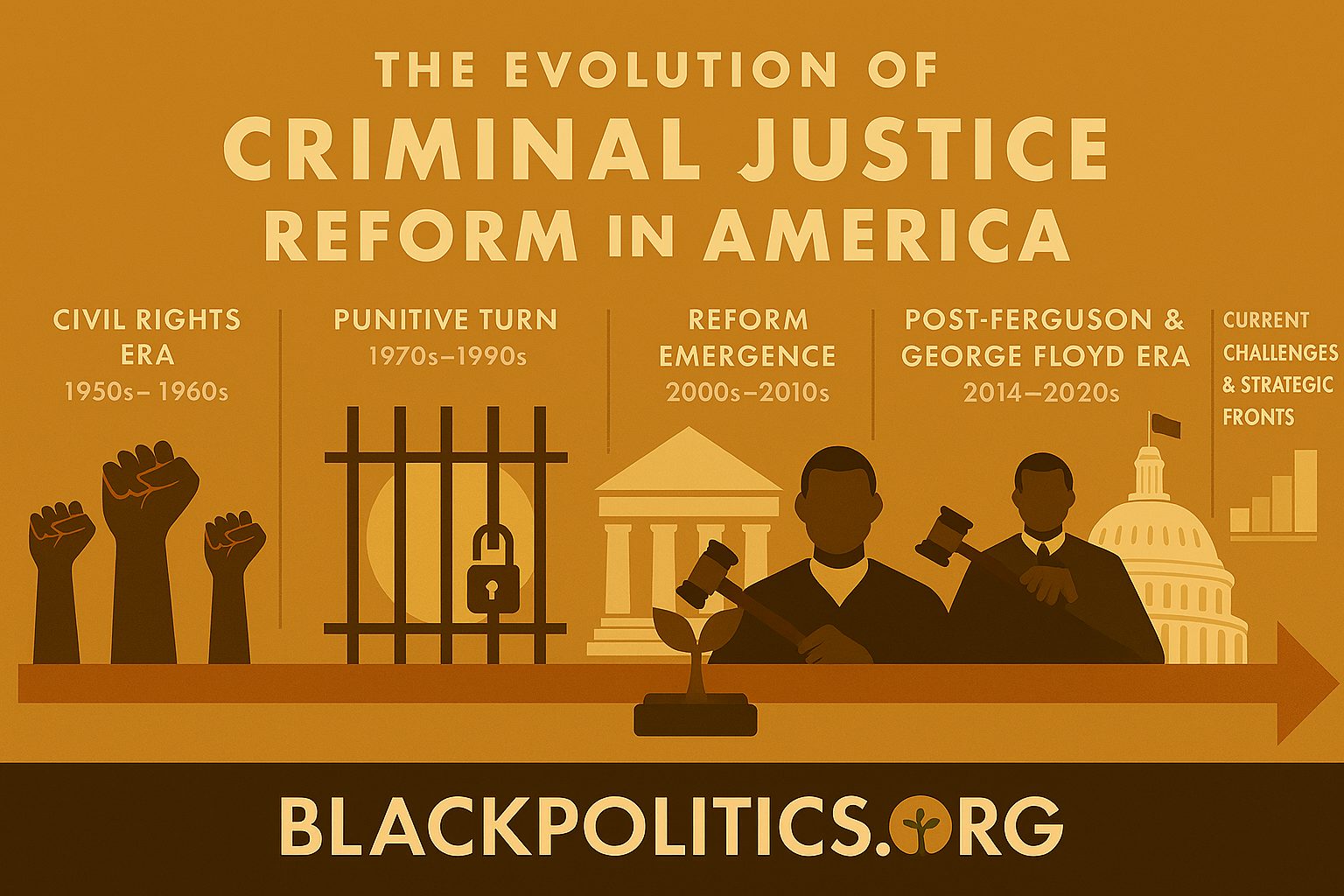
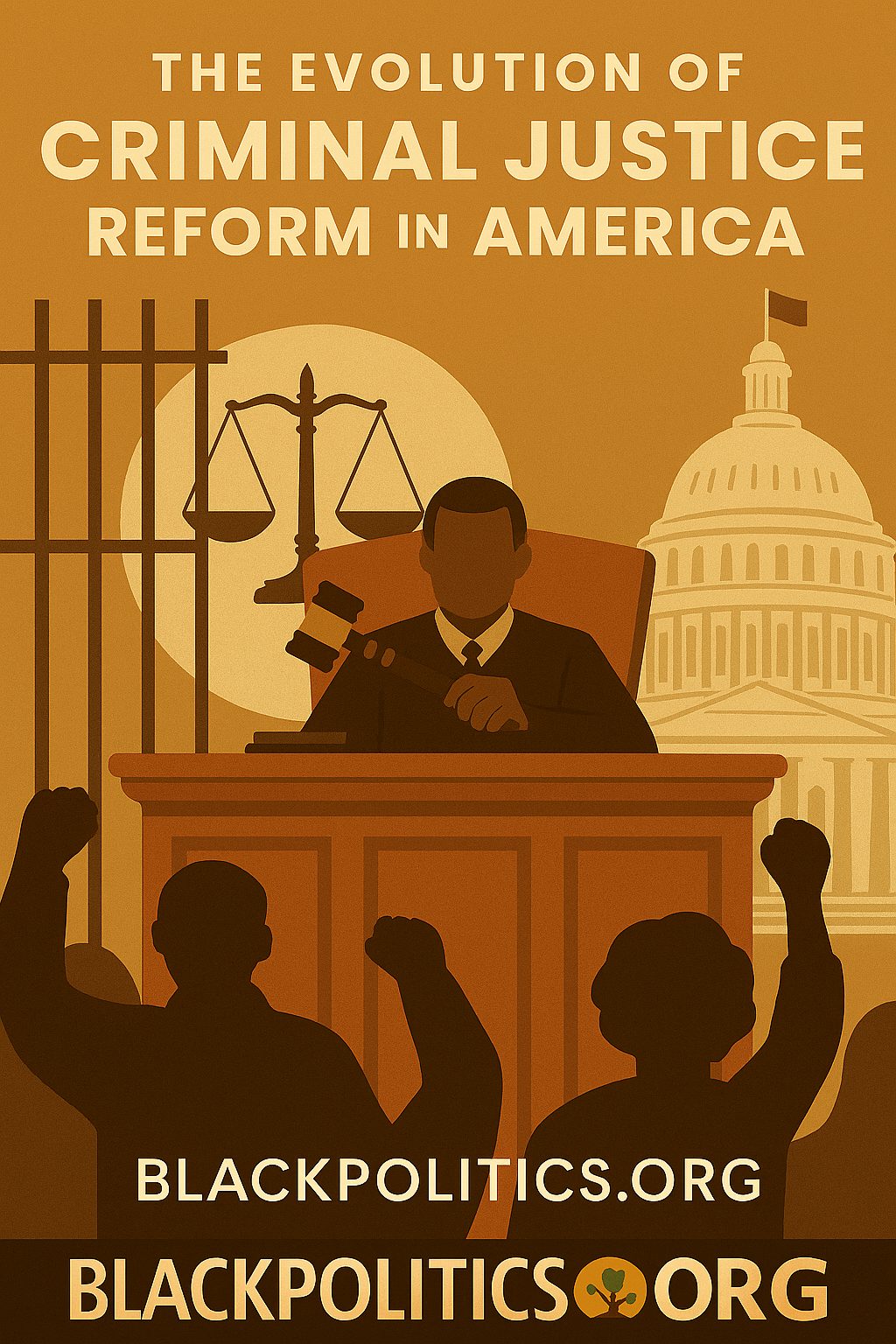
🧭 The Evolution of Criminal Justice Reform in America
A Timeline of Policy, Protest, and Possibility Presented by BlackPolitics.org
1950s–1960s: Civil Rights Era
- Grassroots movements expose systemic injustice in policing and courts
- Landmark reforms: Miranda v. Arizona, Civil Rights Act, Voting Rights Act
- Protest, litigation, and federal oversight reshape public safety narratives
1970s–1990s: The Punitive Turn
- War on Drugs, mandatory minimums, and truth-in-sentencing laws
- Prison population explodes from 200,000 to over 1.2 million
- Racial disparities deepen across arrests, sentencing, and incarceration
2000s–2010s: Reform Emergence
- Bipartisan coalitions revise drug laws and expand diversion programs
- Rise of data-driven advocacy: Vera Institute, Sentencing Project, Brennan Center
- States reduce revocations, expand treatment, and pilot alternatives
2014–2020s: Post-Ferguson & George Floyd Era
- Police accountability enters mainstream policy: body cams, duty-to-intervene
- Federal and state reform bills address use-of-force, decertification, and transparency
- Grassroots coalitions and journalism elevate lived experience and systemic critique
2020s–Present: Strategic Fronts & Judicial Retrenchment
- Supreme Court narrows protections: Shelby County, affirmative action rollbacks
- Attacks on DEI, community funding, and civic restoration intensify
- Reformers pivot to dashboards, scorecards, and civic education as strategic tools
🔗 Legacy and Continuity
Each era leaves behind institutional legacies — organizing models, legal precedents, data frameworks — that shape the next. This timeline anchors our ongoing work to build a justice system rooted in necessity, proportionality, and opportunity.
Explore more at BlackPolitics.org
🔗 Sources & References
- Civil Rights Era: NAACP Legal Defense Fund
- Punitive Turn: Prison Policy Initiative – Reports
- Reform Emergence: Vera Institute – Research
- Post-Ferguson Era: The Sentencing Project – Reports
- Strategic Fronts: Brennan Center for Justice – Criminal Justice Reform

August 24th, 2025
About The Author