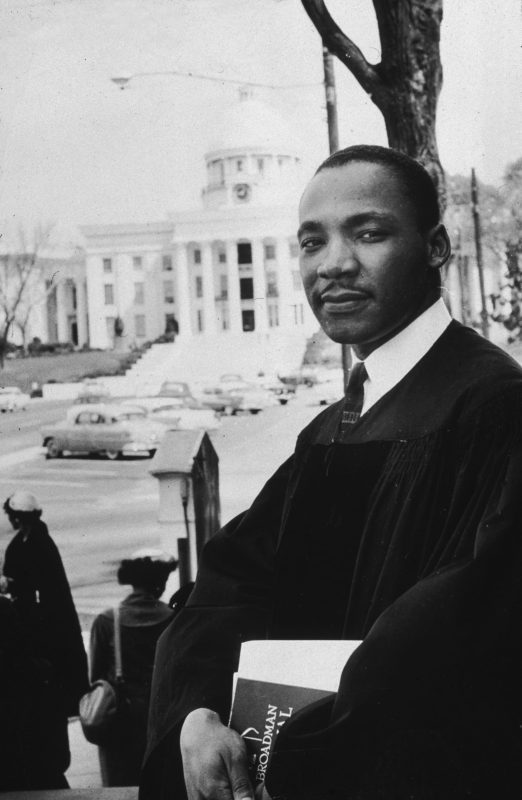
Nonviolent Civil Rights Movement
The Civil Rights / nonviolent, Integrationist movement in Black political history centers on moral appeals, nonviolent resistance, and legal advocacy to dismantle segregation and expand democratic inclusion.
“We hold these truths to be self-evident…” — but for nearly a century after Emancipation, Black Americans were denied the full promise of citizenship. The Civil Rights / Integrationist nonviolent movement emerged to challenge that denial — through moral clarity, disciplined nonviolence, and strategic litigation. Anchored by the Southern Black Christian Church and led by figures like Martin Luther King Jr., Ella Baker, Diane Nash, and Thurgood Marshall, this movement sought to redeem the nation’s conscience and force America to honor its founding ideals.
From the NAACP’s legal victories to the Montgomery Bus Boycott — launched from Dexter Avenue Baptist Church — from CORE’s Freedom Rides to SNCC’s sit-ins, this current mobilized mass participation and media visibility to expose the brutality of Jim Crow. The Greensboro sit-ins of 1960, led by four Black students, ignited a wave of direct action across the South. Fannie Lou Hamer, a sharecropper turned voting rights icon, challenged the legitimacy of the Democratic Party and demanded full enfranchisement for Black citizens.
But this current was not monolithic. It included grassroots organizers, student radicals, and quiet strategists. Ella Baker rejected charismatic leadership and built decentralized networks. Diane Nash led direct actions with unwavering discipline. CORE blended interracial organizing with militant nonviolence. Together, they expanded the movement’s reach and deepened its democratic ethos.
This current believed in America — and demanded that America believe in Black people.
| Year | Event | Impact |
|---|---|---|
| 1909 | NAACP founded | Launches legal strategy to challenge segregation |
| 1942 | CORE founded | Introduces nonviolent direct action and interracial organizing |
| 1954 | Brown v. Board of Education | Declares school segregation unconstitutional |
| 1955 | Montgomery Bus Boycott begins at Dexter Avenue Baptist Church | Sparks national movement; elevates MLK and church-based organizing |
| 1960 | Greensboro sit-ins begin | Launches student-led direct action movement; leads to SNCC’s founding |
| 1960 | SNCC founded with leadership from Ella Baker and Diane Nash | Youth-led organizing and voter registration reshape movement strategy |
| 1964 | Fannie Lou Hamer challenges Democratic Party at DNC | Exposes voter suppression; demands political representation for Black Mississippians |
| 1964 | Civil Rights Act passed | Outlaws segregation in public accommodations |
| 1965 | Voting Rights Act passed | Protects Black voting rights in the South |