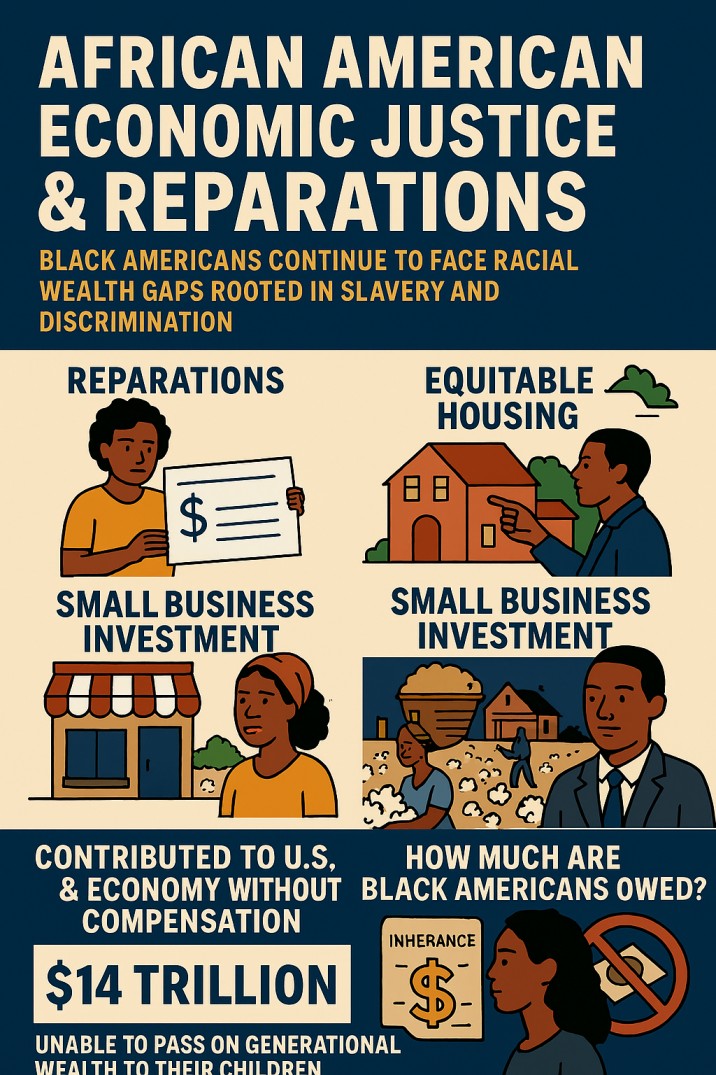
Economic Justic and Reparations Inforgraphic
The Case for Reparations: Economic Justice in the 21st Century
By BP Editorial — Updated 2025
The Case for Economic Justice and Reparations
Reparations and economic justice for African Americans in the US is not simply a question of fairness; it is a demand rooted in history, law, and morality. For centuries, African Americans were denied the opportunity to accumulate wealth due to slavery, sharecropping, Jim Crow laws, redlining, and systemic discrimination in education, housing, and employment. These policies created the racial wealth gap that persists today.
Economic justice and reparations has long been at the heart of Black political struggle in the United States and across the diaspora. Reparations for slavery and its afterlives — Jim Crow, redlining, mass incarceration, and systemic discrimination — represent one of the most debated, yet urgent, solutions for correcting centuries of racial wealth inequality.
Historical Foundations
Calls for reparations date back to the end of the Civil War, when formerly enslaved people demanded “forty acres and a mule.” Although land redistribution never materialized, the demand for compensation continued through organizations like the National Ex-Slave Mutual Relief and pension societies.
That demand for reparations has deep roots in the failure of the Reconstruction Era (1865–1877) to provide economic security and land for newly freed people. Freedpeople’s calls for land and wealth became a core demand that continues into the present-day movement for reparations, which seeks to address the enduring racial wealth and opportunity gaps caused by slavery and subsequent discriminatory practices like the New Deal‘s exclusion and the Jim Crow laws.
The case is simple and straightforward: Formerly enslaved people were denied land, wages, and basic resources to rebuild their lives, creating a cycle of economic dependency that persists to this day.
The Racial Wealth Gap
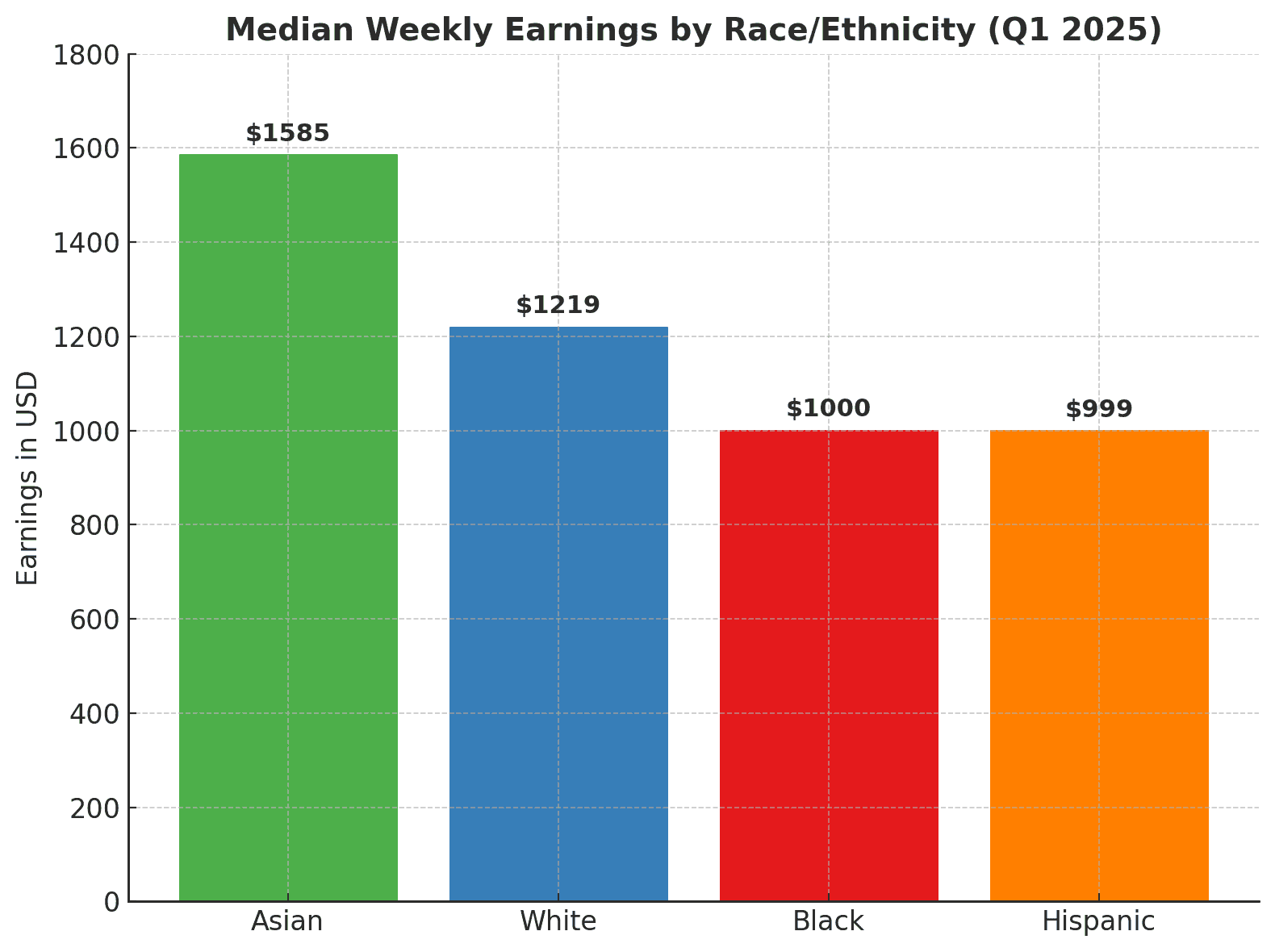
Today, the median wealth of white families is nearly 10 times that of Black families. This disparity reflects structural disadvantages in homeownership, inheritance, and access to credit.It is a cycle that has persisted generation after generation, dating all the way back to emancipation.
Surely it is not unreasonable to understand that after approximately 250 years (1619 to 1865) of enslavement, i.e – brutal subjugation and forced servitude without compensation – people who had endured this started off at an econmic disadvantage when compared to their white American counterparts and would never be able to catch up with their counterparts unless some remedial action was undertaken to remove that disadvantage.
The longer it has taken to correct for that 250 year initial disadvantage, the more persistent the disparity has become as the wealth gap continues to widen. To make matters worse, not only did the correction or remediation fail to happen, but the post-slavery subjugation and continued discrimination continued to expand the initial 250 year injustice.
“Reparations is not just about money. It is about repairing the breach of trust, restoring dignity, and acknowledging the truth.” – Ta-Nehisi Coates
Modern Movements
Today, organizations such as the NAACP, the National Black United Front, and international coalitions continue to demand reparations through legislative efforts like H.R. 40. Scholars like Ta-Nehisi Coates, William Darity Jr., and Kirsten Mullen have strengthened the intellectual case for reparations with historical and economic data. The Malcolm X Grassroots Movement, and predecessor organizations like The Republic of New Africa and the African People Party have historically raised the demand for reparations and land as compensation for the enslavement of and crimes committed against African Americans. Several states and municipalities – including Evanston, Illinois, and California – have initiated local reparations programs.
Global Reparations Efforts
Beyond the U.S., nations in the Caribbean under the CARICOM Reparations Commission have demanded redress from European colonizers. African nations, too, are increasingly vocal in linking global inequality to colonial exploitation.
Global Comparisons
Other nations have recognized the necessity of reparations. Germany paid reparations to Holocaust survivors. South Africa created the Truth and Reconciliation Commission. These examples demonstrate that financial compensation, paired with truth-telling, can advance justice.
Economic Case for Reparations
Research shows that the racial wealth gap between Black and white households is both staggering and persistent. Reparations are not merely about payments; they represent a broader restructuring of policies including housing, education, healthcare, and debt relief.
Reparations and Economic Justice Proposals
- Direct Payments: Cash transfers and land (today’s evuivalent of Forty Acres and A Mule) to descendants of enslaved Africans.
- Institutional Investment: Funding for institutions serving the African American community, like historically Black colleges, also housing, and healthcare systems.
- Policy Reforms: Ending mass incarceration, predatory lending, and discriminatory labor practices.
“Reparations are not just about recompense for the past — they are an investment in a more equitable future.”
Opposition and Challenges
Critics argue reparations are “unworkable” or “divisive.” Yet, similar policies — from Holocaust reparations to payments to Japanese Americans interned during World War II — demonstrate precedent for reparative justice.
Contemporary Examples
- As referneced above, in 2021, Evanston, Illinois became the first U.S. city to fund reparations programs through cannabis tax revenue.
- California’s Reparations Task Force submitted recommendations for financial and policy measures in 2023.
Conclusion
Reparations are not merely a policy proposal; they are a moral and democratic imperative. Economic justice and reparations are about restoring equity and dismantling structural racism. Addressing centuries of injustice requires bold policy, investment, and national recognition of the harm inflicted on Black communities. Without addressing the foundational injustice of slavery and systemic racism, true economic justice cannot be achieved.
Sources & References
- CARICOM Reparations Commission
- NAACP Official Site
- Brookings – Why We Need Reparations
- Economic Policy Institute – The Racial Wealth Gap
- H.R. 40 – Commission to Study and Develop Reparations
- New York Times – The Case for Reparations
- Darity, William A., and Mullen, Kirsten. From Here to Equality. UNC Press, 2020.
- Coates, Ta-Nehisi. “The Case for Reparations.” The Atlantic, 2014.
About The Author