Emancipation to the White House – Black Electoral Politics
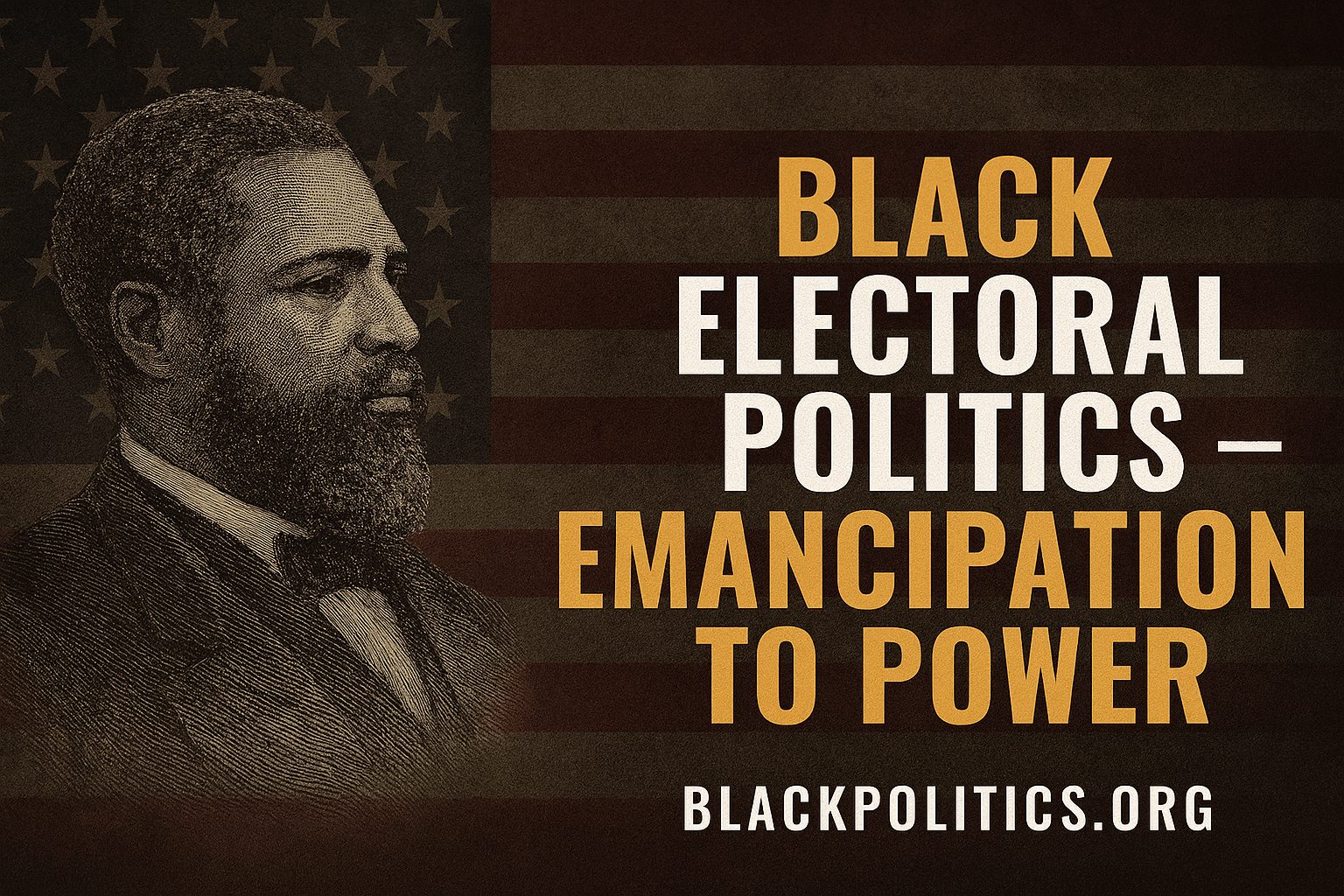
Black electoral politics charts a strategic journey from Emancipation to power. This journey runs through Reconstruction, voter suppression, grassroots mobilization, and landmark victories — culminating in presidential and vice-presidential representation. The Electoral Politics current begins with the passage of the 15th Amendment in 1870, which constitutionally prohibits racial discrimination in voting. This landmark moment opened the door to Reconstruction, a brief but transformative period when newly freed Black citizens exercised political power at every level — electing hundreds of state legislators, rewriting constitutions, and sending representatives like Hiram Revels and George H. White to Congress.
But this democratic surge was violently crushed by a coordinated white backlash. Through paramilitary terror (e.g., the Ku Klux Klan), legal disenfranchisement (poll taxes, literacy tests, grandfather clauses), and federal abandonment of Reconstruction, white supremacists reasserted control. By 1901, George H. White stood as the last Black member of Congress for nearly three generations — warning that “Phoenix-like, he will rise again.”
The current reemerges in the mid-20th century, as civil rights litigation and mass protest culminate in the Voting Rights Act of 1965. This federal intervention reignites Black electoral participation, leading to the election of Black mayors like Carl Stokes and Richard Hatcher, and the formation of national coalitions like the Gary Convention in 1972.
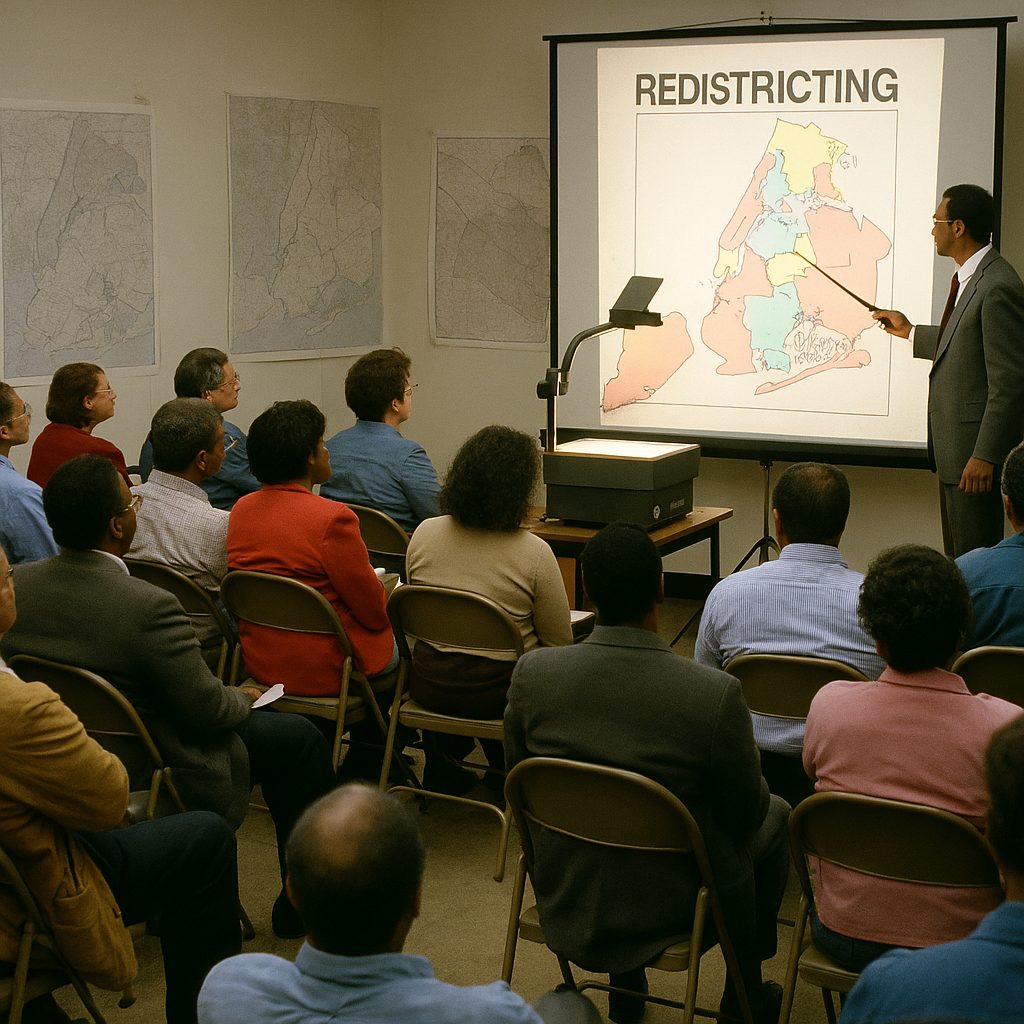
In the 1980s, legal victories such as Thornburg v. Gingles and redistricting advocacy by the Southern Regional Council, NAACP Legal Defense Fund, ACLU, and the Lawyers’ Committee for Civil Rights Under Law result in the creation of majority-Black districts across the South. This leads to a dramatic expansion of Black state legislators and members of Congress.
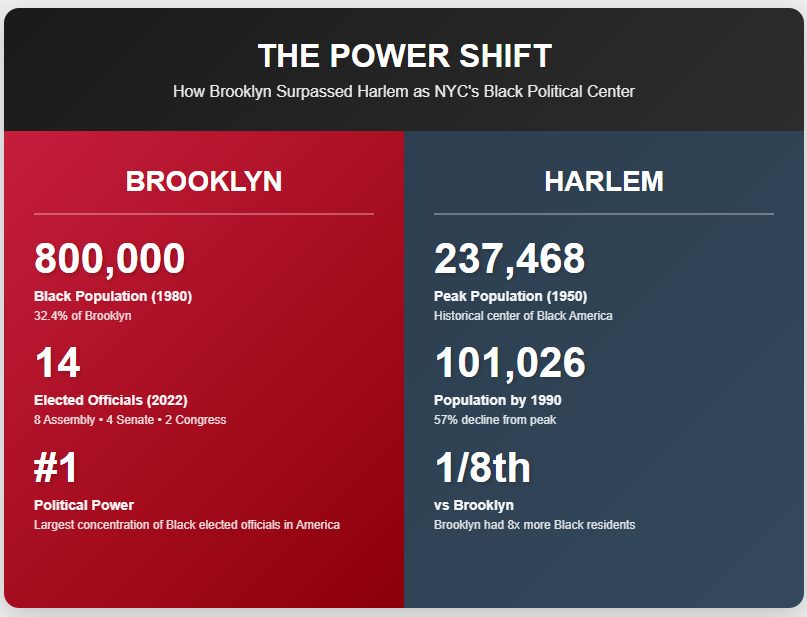
The current reaches new heights with Jesse Jackson’s 1988 presidential campaign, which wins 13 states and reshapes the Democratic Party’s platform. Grassroots efforts like Countdown ’88 and Countdown ’89 mobilize Black voters in urban centers, laying the groundwork for the election of David Dinkins as New York City’s first Black mayor in 1989.
Emancipation to Power
By the early 2000s, over 8,000 Black officials hold public office nationwide — a number that would have been unimaginable during the nadir of Jim Crow. The election of Barack Obama in 2008 and Kamala Harris in 2020 mark the apex of this current’s institutional reach, while victories like Raphael Warnock’s Senate seat in Georgia reflect the enduring power of Southern organizing.
Electoral Politics is not just a current — it’s the gravitational center of Black political life. It operates within the system, reshaping it from the inside, and proving that representation is both a strategy and a battleground.
Timeline: Milestones in Black Electoral Politics (1870–2021)
| Year | Event | Impact |
|---|---|---|
| 1870 | 15th Amendment ratified | Prohibits racial discrimination in voting; foundation for Black electoral rights |
| 1870 | Hiram Revels elected to U.S. Senate | First Black senator; symbol of Reconstruction’s promise |
| 1897 | George H. White elected to Congress | Last Black congressman of Reconstruction era; warns of white backlash |
| 1901–1965 | White backlash and disenfranchisement | Poll taxes, literacy tests, and violence suppress Black voting for decades |
| 1965 | Voting Rights Act passed | Restores federal protections for Black voters |
| 1967 | Carl Stokes and Richard Hatcher elected mayors | First Black mayors of major U.S. cities (Cleveland and Gary) |
| 1982–1986 | VRA amendments and Thornburg v. Gingles litigation | Leads to creation of majority-Black districts and expansion of Black legislators |
| 1980s | Southern Regional Council, NAACP LDF, ACLU, Lawyers Committee lead redistricting advocacy | Strategic litigation and mapping reshape Southern political landscape |
| 1988 | Jesse Jackson runs for president | Wins 13 states; reshapes Democratic Party and expands Black electoral imagination |
| 1988–89 | Countdown ’88 and Countdown ’89 mobilize Black voters | Grassroots voter education and turnout campaigns in NYC |
| 1989 | David Dinkins elected mayor of New York City | First Black mayor of NYC; coalition politics in action |
| 1990s | Majority-Black districts expand across South | Surge in Black state legislators and members of Congress |
| 2008 | Barack Obama elected president | First Black president; culmination of post-civil rights electoral strategy |
| 2020 | Kamala Harris elected vice president | First Black woman VP; expands representation at executive level |
| 2021 | Raphael Warnock elected to U.S. Senate from Georgia | First Black senator from Georgia; victory rooted in Southern organizing |
Black electoral politics remains the heart of the struggle — the fight to be counted, represented, and heard. But that fight has never stood alone. It has always required protection when laws failed, alternatives when systems resisted change, global allies when justice demanded a wider lens, and cultural truth-tellers to ensure the story was never lost.
It is essential for subsequent generations of Black activists and organizers to understand the centrality of Black electoral politics. Black Politics contends that this centrality cannot be fully understood or appreciated without first studying the level of African American electoral representation achieved during Reconstruction — what that representation accomplished, and why it was violently dismantled.
BlackPolitics.org is organized to help readers trace the living history of Black political power. Each section reflects a distinct current in the Black freedom struggle:
- Electoral Politics,
- The Civil Rights Movement, which sought to restore Black representation after its destruction,
- Unarmed and armed self-defense, along with Black nationalist movements, which emerged in response to the repression of nonviolent, integrationist efforts, and
- Revolutionary Black nationalism, which fused those strategies into a broader vision of autonomy and liberation.
Through timelines, narratives, and archival resources, the site shows how these strategies evolved, overlapped, and responded to changing conditions. Posts are grouped into thematic hubs, making it easy to explore by era, region, or strategy. Whether you’re a student, organizer, or researcher, the site is built to guide you through the infrastructure of Black civic life — past, present, and future.