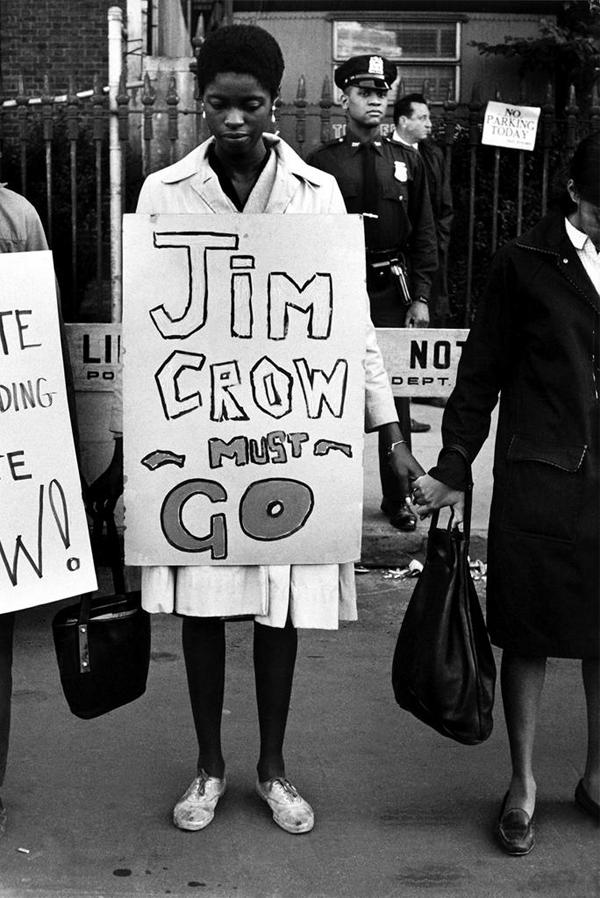
"Jim Crow Must Go," Date Unknown
[ad_1]
Historical Overview
Prior to the modern African American Civil Rights movement, Black women were already active participants in the struggle for social justice in the United States. Organizing through churches and eventually through the creation of Black women’s clubs, a movement which began in earnest toward the end of the nineteenth century, there is a tradition of service and sacrifice that is foundational to Black women’s continued organizing efforts. The creation of the National Association of Colored Women’s Clubs, the National Council for Negro Women, and other similar organizations help to lay the foundation for women’s leadership during the modern Civil Rights Movement.
The Civil Rights Movement cultivated a culture in which participants, particularly women, began to question and challenge societal norms. For Black women who grew up in the church, participating in the movement transformed their understanding of their role in the community.
You have to understand that I grew up in a church, and the women sat on one side in the Amen Corner and the men sat on the other side in the Amen Corner. The pulpit was in the center, and the only time the women went up was on Women’s Day. Now, the civil rights movement was the one time I saw women going up into the pulpit because they were leaders of the civil rights movement…I say the leadership structure changed…The woman was the most powerful person in the local community…
While the Black church could be a place where Black women expressed their leadership qualities and exerted occasional influence, ultimately Black men led these religious institutions and were the primary decision-makers. So, while some women participants began to more openly challenge male dominance in the movement, they were still kept from holding leadership positions in organizations such as the Southern Christian Leadership Conference (SCLC). The women leaders of the African American Civil Rights movement however, did not let these types of slights stop them from continuing to do the necessary and important work.
Scholar Janet Dewart Bell cites three modes of Black women leadership during the Civil Rights Movement: transformational leadership, servant leadership, and adaptive leadership. Eschewing leadership from the top-down, transformational leaders such as Ella Baker, encouraged people to develop their own approaches and supported them emotionally, materially, and logistically to achieve their goals. Transformational leaders motivate and inspire others by being reliable, transparent, and inclusive, thus bringing more participants into the fold. Servant leaders have little interest in gaining powers for themselves and instead “embrace work without recognition,” however they knew when to utilize strategy recognition in order to help foster the work and galvanize participation in the movement. An example of this is Jo Ann Robinson, Alabama educator and leader of the Women’s Political Council in Montgomery. Robinson organized the bus boycott and handled day to day operations, while allowing men like E.D. Dixon and emerging leader Dr. Martin Luther King Jr to be the public facing leaders of the Montgomery Improvement Association. Finally, adaptive leadership is most concerned with ensuring that leaders can thrive and receive the support necessary to continue the arduous work of social and political organizing. Like their male counterparts, Black women faced threats of violence. The social support networks they created allowed them to adapt and persevere.
All of the figures highlighted in this document exhibit at least one of the types of leadership models described by Bell. Each woman and her experiences with gender and race discrimination shaped how she responded to external pressures and navigated her role in the movement. Exploring this allows us to better understand how Black women willing put themselves in the line of fire to become the architects of a cultural shift that sought to rid the nation of the vestiges of slavery and its afterlives, not for personal gain, but for the future of their communities.
[ad_2]
Source link
About The Author