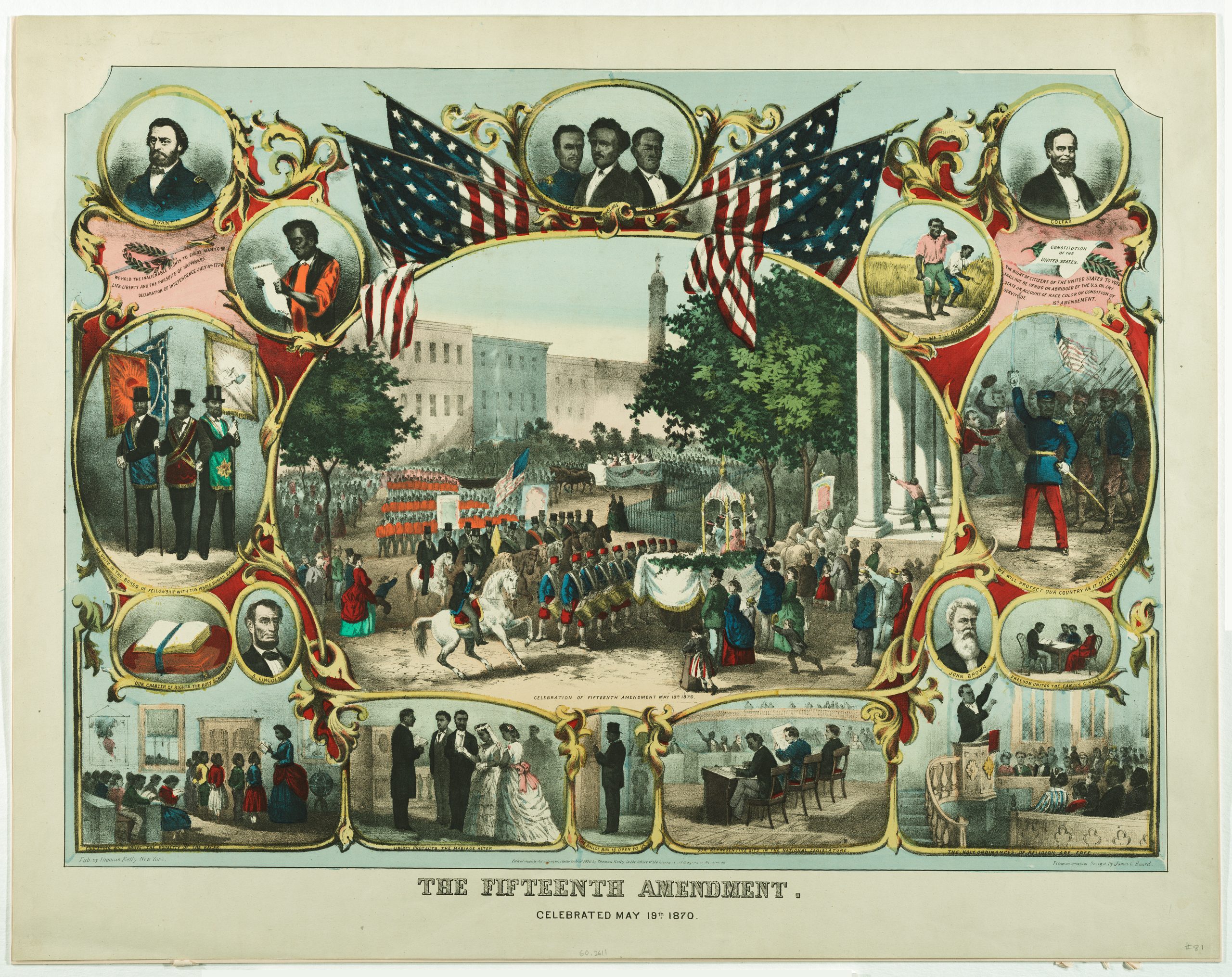
A commemorative print celebrating the ratification of the 15th Amendment. <p class="figcredit">Smithsonian National Museum of American History</p>
[ad_1]

Courtesy of the Social Law Library, Boston, Massachusetts.
That joy flowed from a great sense of inclusion and victory. African American attorney Robert Morris exclaimed to great applause, “Fellow citizens! How good that word sounds to-day. It is the first time I have been privileged to say that in this hall.” The Boston Post reported that abolitionist and woman’s rights activist William Henry Channing sounded the same note in his speech,
He said it was the first time he was ever fully at home in Faneuil Hall. He had always thought when we made the old Cradle of Liberty rock with our boasted professions of Liberty, the amens stuck in our throats. But to-day we are at home in Faneuil Hall, as one great family in the old Bay State.
Those assembled declared that victory completed, even perfected the republic. New Bedford abolitionist Rodney French said that the Civil War found “its consummation in the Fifteenth Amendment.” Channing declared “the ‘glittering generalities’ of the Declaration of Independence, ‘all men are created free and equal,’ are true now.” The first resolution adopted by the gathering saw the amendment as “the continuation and completion of the work commenced by the fathers of the Republic” which would lead to “the full realization of a democratic form of government, and will place our country before the nations of the earth in her true light, a living example of a great and free republic.”
The celebrants did acknowledge that the nation had not yet achieved that “full realization.” While the 15th Amendment guaranteed the vote for all men, women were still excluded. Susan B. Anthony, Elizabeth Cady Stanton, and others were so angered by this that they simply condemned the amendment. Lucy Stone was one of those who took a different tact. She saw the amendment as one necessary step towards full freedom. According to the Boston Post, Stone
made a brief but spirited address, congratulating the colored citizens upon the success of their vital measure, and expressing hope for the speedy extension of the suffrage to woman. Her remarks were applauded, and a hearty ‘yes’ accorded to the proposition that the colored men should join hands with the women in the movement.
The celebrants also recognized that the “living example of a great and free republic” was by no means a given thing. One resolution called upon the newly enfranchised “to guard with ceaseless vigilance and jealousy the priceless boon of liberty and the valued privilege we here celebrate.” That guardianship would be sorely needed. Despite Lucy Stone’s “hope for the speedy extension of the suffrage,” women would not win the vote for themselves until 1920. Opponents of the three Reconstruction Amendments used fraud, trickery, and open violence combined to steal African Americans’ hard-won citizenship away from them. But while that call to “guard with ceaseless vigilance and jealousy” went underground it never died. It was taken up again by the physical and spiritual descendants of these 1870 celebrants as they fought to make the nation “enforce this article.” The Civil Rights Act of 1964 and the Voting Rights Act of 1965 were both the continuation and the outcome of the great struggle celebrated in Faneuil Hall 150 years ago.
Wendell Phillips gave the last speech of the day. He said that the 15th Amendment was a matter of simple justice rather than a gracious gift. He described white Americans as “Bankrupt debtors, [who] can give nothing” to African Americans. Instead, “penitent for past crimes we welcome a wronged partner to an equal share in the privileges we enjoy.” For us, those words contain joy and a great challenge. Where do you see “wronged partners” struggling for inclusion today? How do you think we should respond, keeping in our minds the words of our forebears 150 years in Boston’s own “Cradle of Liberty?” We leave it to all of you to discover your own answers to those questions.
Contributed by Merrill Kohlhofer, Park Guide
[ad_2]
Source link
About The Author